Test of Time 8.15: Better Davis: City Leadership?
Krovoza's Lapdog,
Steve Pinkerton flunks his probationary period
Too many stories - doesn't care to hear anybody including Department Heads
There are 4 city council votes to support Paul Navazio for City Manager
History Repeats:
In 1989, the Davis Test of Time was invented to build a case to replace the Davis Mayor, the Davis City Manager, and the UCD Chancellor; it took 3 years.
"The council just doesn't seem to understand that its win-at-all-costs strategy is ultimately a losing hand. The people have a right to make bad decisions. You simply can't say this thing is too important to trust to the voters. City Attorney Harriet Steiner's "opinion" was outcome based from the get go. Reach your conclusion first and then go backward to justify it. That's advocacy, pure and simple, but not good law. We need the Test of Time." -- Bob Dunning
KROVOZA'S LAST STAND
In his 17 months on the city council, Mayor Krovoza has been bogged down with repeated setbacks in the water rate approval process that should have been his road to glory. Within Davis governance, his one and only attempt to actually push through an idea was his September 2010 announcement to staff to have mandated reverse diagonal parking, which blew up in his face. Since then, he has tried to force little things behind the scenes, with disappointing consequences.
Krovoza's council campaign was strategically unspecific because he could get away with it given the way he interpreted his frontrunner status: don't take any positions that might offend a potential voter. So he kept his plans to himself. While he came in first he did not carry a mandate for anything in particular beyond bicycles. And yet, he has acted as though his coming in first gives him the powerful authority to be a Strong Mayor: personally ordering city employees around and changing city policy by arbitrary decisions rather than a majority vote of the city council after publicly noticed informed discussion.
Sidebar: The legal system that Davis has is a "Weak Mayor/Strong City Manager," where the Mayor needs two more votes just like any other council member, and so has to actually cooperate with the rest of the council. The binding state law is that a majority of the council picks the Mayor. In a Strong Mayor system, the Mayor has hiring, supervision and firing authority; with the Weak Mayor, the City Manager "serves at the pleasure of a majority of the council" and has supervision and hiring authority for all other city employees. Another feature of the Weak Mayor form is that council members including the Mayor are legally limited to only communicating with one city employee: the City Manager. All communication, legally, between council members and staff is limited exclusively to the City Manager. By design.
Krovoza acts like he has the powers that Sacramento's elected Mayor Kevin Johnson is trying to gain statutorily.
Krovoza feels that as Mayor his word should be boss to all city staff, and the city manager should honor the Mayor's wishes. Krovoza has rarely actually gone through the city council process of taking his ideas to the rest of the council via email/memo for a potential majority decision. Most of Krovoza's hands-on policy style is to call up the City Manager or some other city employee - spur of the moment - and tell them to change something. Usually not opening with a question but with an order, of a decision Krovoza has already unilaterally made and expects to be implemented immediately.
But Interim City Manager Paul Navazio was unwilling to automatically accommodate Krovoza's dictates. Whenever conflict and confusion arose, Krovoza blamed Navazio. The problem really was that Krovoza wanted to name his own city manager no matter what, so he was going to find fault with whomever the Asmundson/Saylor administrations had as Interim City Manager (Kelly Stachowicz would have been a profound alternative), so it appears that Krovoza was creating a hostile environment for the Interim City Manager so that it would be that much easier to get someone he could dominate.
No one knows what will happen with the public works department, but Krovoza wants to turn it into his personal playground. Krovoza went to a technology high school and is a closet engineer.
Former Bike Pedestrian Coordinator Tara Goddard was usually at the listening end of a screaming Krovoza demanding that she ignore the facts, ignore previous decisions and ignore her best professional judgment, because Krovoza has seen a better way. Tara Goddard was probably Krovoza's number one target for removal from city staff. There is said to be a list of ten names, nine to go.
KROVOZA'S PERSONAL CITY MANAGER
Mayor Krovoza found a soul mate in his personal city manager, Steve Pinkerton. They both love to talk. And couldn't care less to listen. They are so busy showing off how much they already know that it doesn't occur to them that 1) there might be part of the picture they haven't seen/figured out yet, or even 2) they don't have a clue what they are talking about, but that never stops them from making decisions and ordering city staff around. Both Krovoza and Pinkerton expect "collaboration" to consist of saying "Yes Sir."
It is a wonder what they do when they are together without anyone else? Both talk all the time? No, they enjoy each other too much, and listen respectfully to each other's fascinating brilliance. After all, they are in charge. They have all the time they want, and they are only accountable to each other.
Both Krovoza and Pinkerton are story tellers. The problem is that Pinkerton is so busy telling stories about previous exploits in Long Beach (have you heard about his wife's restaurant?), Stockton and Manteca, that he didn't get your name or anything about you, but now you have spent time with the new city manager, real quality time, even though you didn't get to say much of anything. Pinkerton already knows the answers anyway.
Pinkerton's claim to fame is what he has done in economic development. His experience aside, three months into the job, Pinkerton still doesn't actually know anything about the Davis economy. Every single meeting he has had with members of the Davis business community has been Pinkerton's one-way stories about his distant past, as though he was going through a job interview that he is not prepared for. The representatives of the Davis Downtown Business Association and the Davis Chamber of Commerce throw up their hands in frustration when they tell hideous war stories that Pinkerton did not have any time to understand their concerns because he was so in rapture telling them about Long Beach, Stockton and Manteca. Did you know that Pinkerton's wife opened a restaurant once?
Krovoza expects Pinkerton to complement his skills set and cover for him. Pinkerton really only knows about Davis what Krovoza has told him. Which in terms of the business community, is 3rd or 4th hand at best because Krovoza has not even made time to attend the city's business discussions. The Davis economy is Krovoza's weakest policy area, and he takes it for granted. Mayor Pro Tem Rochelle Swanson and the business community worked really hard to put together an initial meeting, to find out who the players are at the Davis table. Called "Who's On First?", 54 people showed up with something to say about their contribution to Davis economic vitality. An hour later, when everyone was done introducing themselves, Krovoza shows up, makes a speech cold without hearing what anyone else's concerns are, and then Pinkerton checks out, missing the discussion half of the event.
Wouldn't you think that if Pinkerton really cares about economic development, he would want to hear what the key people are thinking about? If it is his #1 concern, don't you think it would be the kind of event where Pinkerton would have his sleeves rolled up, and looking and acting like he is interested in engaging the Davis business community in a serious discussion about building the local economy. There has been Zero evidence that he has a clue how to do economic development for Davis.
Since Krovoza hadn't been in on the introductory foundation of the "Who's On First?" conversation, he had no idea what it was about, or why it went the way it did. The theater company wants restaurants to stay open after their shows close at 10 pm. That drove a discussion of communication between different businesses. Krovoza understood less than everyone who sat through the entire meeting. That is the only one of a half dozen city meetings on economic vitality that Krovoza attended. Krovoza is checked out on business: what he says is hot air.
Then a meeting with the new UCD Vice Chancellor for Research Harris Lewin to talk about how to collaborate between new campus innovation and the Davis business community drew 25 people, but neither Pinkerton nor Krovoza considered it important enough to attend. Lewin is the real deal, a world class cancer scientist who has had increasing administrative responsibilities and to a bunch of business people sounded like a venture capitalist. Long ago, he earned his Ph.D. at UCD, and he started by saying his major professor at UCD started a business, so he has always thought of entrepreneurial innovation as an integral part of the university mission. Lewin said more in any 5 minutes about Davis economic development than Pinkerton has said in his three months "on the job."
Of the dozen key meetings of concern to the business community during his three months, Mr. Economic Development specialist Pinkerton has attended the half of two meetings where he was the focus, and then left when other people started talking..
When either Pinkerton or Krovoza actually do meet with a business person, they are so busy talking that they don't listen. Pinkerton and Krovoza don't listen to the point that it is next to impossible to get any new versions of the situation (like maybe reality) into their thinking when they discuss particular policy conclusions that they intend to impose. And since they only know what each other has already confirmed, it is extremely difficult to get either Krovoza or Pinkerton to realize that they are operating from invalid assumptions. The problem is that they don't care to find out that they need to update their views; when asked to, they refuse to listen. That is usually referred to as "the arrogance of power."
Since Pinkerton mostly knows what Krovoza tells him, or from the standpoint of the way that Krovoza tells the story, Pinkerton only has a piecemeal view of the city, inappropriately deferring to Krovoza's views. Since Pinkerton is only accountable to Krovoza, he doesn't have to worry about the "whole city" and actually take over the reins of the government - actually take responsibility for the cumulative consequences of decisions and actions, as well as actually jump in and take charge, like he is a strong city manager and knows what he is doing. Krovoza's ego is so demanding that he has found someone who is willing to be a Weak City Manager. For Krovoza it is the way to misuse a Weak Mayor/Strong City Manager structure to fit his ego: Krovoza found somebody who is willing to be bossed around.
It looks like Pinkerton is an economic development grant hack, who really doesn't have a clue how to run a city, let alone take an economic mess in trying times, and figure out how to benefit from the University, which Pinkerton has so far been silent about.
Pinkerton hasn't engaged anyone in the business community: to actually ask questions, partly because Krovoza is confused about what he wants to do beyond "sustainability" and Pinkerton is taking his cues from Krovoza rather than the entire council. Pinkerton doesn't actually know what it takes to be a city manager. Pinkerton is a bureaucrat who specialized in getting grants for economic development when that was a useful skill. That gravy train has dried up. Economic development now means sitting down with real people with ideas who are trying to overcome tremendous challenges in this tight economy. Not for one minute has Pinkerton engaged the business community in that discussion: Pinkerton is too busy bragging that he did it before, in Long Beach, Stockton and Manteca. Pinkerton must have learned a lot about how to run a business when his wife opened that restaurant. Can't imagine what he' has learned in his time in Davis?
What about the cost of lost opportunities? How much does Sue Greenwald cost the city each meeting? Neither Krovoza nor Pinkerton has a clue what to do to have Sue Greenwald as a productive member of the discussion. The overall lack of focus and direction of the council can be blamed on Sue Greenwald's hysterics but it still seems that Krovoza only wants to be in power so he can do whatever he wants, with no particular course of action or medium term quantified objectives.
Roger Storey learned more about the Davis economy in his first 3 hours on the job of City Manager than Pinkerton has learned in his entire 3 months collecting a paycheck.
NOW KROVOZA IS REALLY IN CHARGE
All the problems Krovoza had with Paul Navazio have now disappeared. Pinkerton doesn't say "you can't do that". Pinkerton doesn't give five reasons why it won't work, why it is so unrealistic that it never should even be discussed. Because Pinkerton doesn't care, he doesn't know what he is talking about, and he doesn't want to have to find out and then have to be responsible enough to get back to Krovoza to tell Krovoza he is wrong.
And, that Krovoza is mini-micro managing so much that he refuses to even hear what are the real issues of concern. Krovoza could tell you the hundred things Davis should do, but he can't tell you the three things he is accomplishing and why they take priority. Where Don Saylor was EGO, History, Nice Talk, no substance (imitation warm fuzzies), Krovoza is EGO, Nice Talk, Big Smile, no history, no substance, no resolution (confused imitation warm fuzzies). Krovoza learned a lot from Saylor during his six month apprenticeship as Mayor Pro Tem about how to be a bully and boss city staff around. What Krovoza did not learn was how to work a project through the city process, so he assumes that whatever he wants to do is the right way to do it. No City Hall has ever worked that way. The History of New York City, for example, could well be described as how the Mayor battles City Hall at every turn and sometimes on the straightaway. That is why any community needs a mayor, to help work through the decisions; Krovoza on the other hand just thinks his point is the final decision.
At each successive city council meeting, Krovoza has spent the least amount of time reading the agenda packet and speaking with the respective communities of interest; Krovoza is least likely to be listening during presentation because his mindset is to already have a final decision and then drive towards it - too often ignoring information counter to Krovoza's predetermination.
Someone in a position to work with all of Davis' council members over the past 25 years says that some people are ignorant because they are un-informed, but some people are ignorant because they refuse to listen, and Krovoza is the most ignorant council person in their experience. Most un-educatable. Stuck in his egotistical rigidity.
Part of the problem is that Krovoza is attempting to implement a Strong Mayor form of governance within a Weak Mayor/Strong City Manager form of government. It only increases confusion. Dave Rosenberg is the closest Davis has ever come to having a Strong Mayor who was successful, all be it with a three vote majority the first time. Rosenberg drove Jerry Adler crazy with personal initiatives that he publicly announced and then brought to the city council for ratification. The most significant was the still-born and occasionally reborn "Association of Mayors of University of California Cities." But Rosenberg only got away with it because he knew he already had majority endorsement for the idea, he just hadn't gone through the formal part, which included informing Adler and requesting his support, but expecting irrelevant opposition, so why worry about it. There was too much of that towards Adler by the Rosenberg/Evans/Corbett Gang of Three whose cavalier design of the 1987 Davis General Plan precipitated the Davis Test of Time.
The art, the MAGIC, of the Weak Mayor form of council is based on the courtship of "counting to three." It is something that happens behind Krovoza's back. He is rarely involved except in lobbying other council members for his position. Krovoza is rarely the Mayor in the sense of being in the middle - his personal position always takes priority to the point of clouding his understanding of the rest of the council.
HAVE YOU DRILLED your PERSONAL WATER WELL?
The water rate issue is the biggest example of where Krovoza has lost the council but thinks he is in complete control. Krovoza was ambushed by Dan Wolk's alternative resolution, and Krovoza still refuses to respect the critics of the way the rate decision is happening.
What should be the crown jewel of a successful Krovoza administration, the grand water plan has become a clumsy disaster in terms of the process. Given Krovoza's history as a water lawyer, and his campaign claim to be an expert at public finance and big projects, this process should have given Krovoza the golden opportunity to shine as a leader who can carry a project to successful implementation.
At several significant steps, the petition gatherers and Dan Wolk have ambushed Krovoza. 1:30 a.m. in the marathon September 6th city council meeting Wolk brought up an exhaustive list of ways to improve the project process that completely surprised Krovoza. Not surprising, the list included a variety of ideas which had the finger prints of Wolk's parents, the former dean of the UCD law school and the state senator who is past chair of the assembly committee on Water, Parks and Wildlife and past Mayor of Davis. Krovoza made a deal in the heat of the moment, taking all the list in exchange for a 5-6 year rate increase package which was the only thing he cared about. That is part of the problem: Krovoza is impatient to get to the finish line to have something big.
On a fundamental level, what Dan Wolk, and Rochelle, get, and Krovoza doesn't have a clue about is that the water rate political controversy has gone way beyond the 218 requirements. Davis body politic, especially Enterprise columnist Bob Dunning, left that one behind long ago. No, this is about the fundamental credibility of the elected officials. At this point, the critics are specifically questioning the authority of Krovoza and Stephen Souza to make decisions on the water project Joint Powers Authority on behalf of the city of Davis. At question is their ability to be representatives.
After the more recent council meeting accepting the County Clerk's certification of the petition signatures, at midnight Pinkerton made public the city attorney's two week old "finding" that the city council could ignore the petition. Heretofore the city attorney's finding was "confidential" because of client attorney privilege because it was POLITICALLY sensitive: How many more people would have volunteered to carry petitions if they knew that the city attorney had already given the city manager the legal backing to ignore the petition? Following the email, Pinkerton and his staff presume that is the end of it: the city attorney said the council could ignore the petition and certify the rate increase; now the council can get on with the rest of the normal business of the city.
The way Pinkerton released the information about the city attorney's recommendation that the council actually ignore the petition for the vote on the water is such bad politics that Krovoza is in big political trouble. Unfortunately for Krovoza, the rookie city manager who should be in the best position to help him is the person making novice mistakes.
This is blatant arrogance of the new city manager. It is the electoral equivalent of the UCD police pepper spaying the motionless demonstrators three days later. It shows the complete disregard for the public process, the voters/taxpayers and the rule of law. When the petition leaders found out what the city manager did, they threatened to recall the 2010-14 council members, Krovoza and Swanson. [Rochelle lit up with delight at the prospect. Now that she knows what is going on more than anyone else, she has a story to tell.]
INSIDE CITY HALL
For the same reason that Pinkerton and Krovoza get along so well, Department Head meetings with the City Manager have become a worthless joke of listening to the boss tell more stories that mostly don't even have anything to do with the topic but are irrelevant anyway. If anyone else in the room ever did it twice, they would be reprimanded in the second meeting by the group and by the boss. But everybody has to indulge the boss.
With the second sentence of yet another worthless Pinkerton story, out come the cell phones to read email messages. Nobody has to pay any attention because the city manager is on automatic pilot. At least when Antonen was the city manager, the department heads had to work during their weekly meeting. Now it is productive only as personal time or side comments with other department heads that the city manager doesn't get and has no interest in. The meeting hours slowly creep by, as little or nothing of substance is even mentioned because the boss is too busy talking.
When Pinkerton walks into a room of Davis city employees, the room suddenly tenses as everyone is unsure what Pinkerton might possibly want. It is not likely to be good: Krovoza has a cut list. Getting rid of Bike Pedestrian Coordinator Tara Goddard was high on Krovoza's list. No telling who else is on it.
KROVOZA THE EMPTY SUIT
I supported Krovoza strongly from August to November 2009, lobbying key Davis people to support him for the June 2010 election. Then for three months, Krovoza taunted me to find a position in his imaginary campaign and he rejected each thing I proposed. Then Leo teased me to apply the Viable System Model to Krovoza's campaign, and I realized that I couldn't begin to, because Krovoza doesn't trust me at all. He is like that with a lot of people, too many people in Davis.
The good news is that since Ruth Asmundson left the council at the end of June, 2010, Rochelle Swanson has stepped into the breach as "de facto Mayor." Where Stephen Souza claims years of service (what the academics call "seat time" - the body is there but the mind is not engaged - has been used about Stephen in particular), Rochelle has been busy doing council service: actually listening to Sue Greenwald, and Stephen, as well as Krovoza, and of course Dan Wolk. Behind the scenes, it is Rochelle who has been doing her homework, listening to as many people as she can about a particular issue, working to be sure she understands all the sides, and learning what issues concern the sides, as well as what becomes the determining issues, for city staff and for her council colleagues. The behind the scenes work to settle the social friction - the art of the possible. What a society needs its Mayor to do.
Rochelle has out-thought and outworked Krovoza on every issue and every agenda item. Rochelle has out-thought staff so often they go to meetings with her for the fun of finding out what an engaged council member can add to public policy.
Krovoza is so busy in his day job at the university that he rarely has time for council business. He only shows up if he is scheduled, and then he is always rushed and usually late. Krovoza doesn't have time to have casual conversations with constituents, the glue of social intercourse, so he doesn't find out new information, and goes on what he thought before, even if others are changing, or worse, have already changed, leaving Krovoza behind. Wait. Isn't Krovoza supposed to be the "leader"?
Krovoza does power meetings on behalf of Davis, but he doesn't have time for Davis. He is respected at UCD, but there is not a single city employee who Krovoza has shown respect to besides his boy Pinkerton. He learned how to show dis-respect from Don Saylor, his mentor, and as Krovoza sees the POWER of having the office of Mayor for three and a half years, it means that he can do any-bully-thing he wants for a long time without any personal consequences except sullen city employees who don't jump at Krovoza's every whim.
Krovoza doesn't care about Davis; Krovoza only cares about Krovoza. Krovoza has a listening disability, the worst handicap a politician can have. First off, Krovoza talks non-stop (which is now called "Sue Greenwalding" someone), and just expects the listener to agree with the brilliance. When someone tries to disagree with him, Krovoza argues rather than listening to learn. Then Krovoza's brain just goes in another direction, and his subconscious actually gives the other person a courtesy: Krovoza starts saying "yeah, yeah, good, good; yeah, yeah, good, good," which is the sign to shut up and submit to Krovoza's superior ideas because you are just wasting your breath: no one is listening or cares about a word you are saying. And, Krovoza's brilliant thought is going to be so good that you are really, really going to appreciate the fact that Krovoza cut you off. Nice smile just before he cut you off.
Krovoza has turned unlistening almost into an art form; when he is being presented with information at a meeting, there is no telling where his brain is. Krovoza has had over a year, and he is a complete failure as "an elected official" because he cannot represent beyond his own personal opinion, just like Sue Greenwald. Hard to say who is worse for the city of Davis, Sue Greenwald or Joe Krovoza.
Krovoza is so arrogant that there are only about a dozen, maybe twenty Davis citizens that he listens to: the members of the school board, people he has appointed to the planning and natural resources commissions, four people in the bicycle community. Sue Greenwald has maybe a dozen people, although Mark Siegler is the only person who can tell her that she is wrong, so shut up and listen, and she actually does. Stephen Souza is so squirrelly that he will tell you whatever he thinks you want to hear. Dan Wolk is still the deer with his eyes in the headlights, will listen to everybody, as he is trying to figure out what he is really doing now that he is actually on the council and he has the opportunity and responsibility to face the voters next June. By comparison to the maybe three dozen people who actually influence those four individual council members, there are HUNDREDS of people who will say that Rochelle Swanson has asked their opinion, listened and then took their concerns into account in her thinking about the problem in particular and Davis in general so that when she is thinking about other problems in the future, Rochelle will keep those concerns in mind.
NEED A REAL CITY MANAGER
The chronic crisis in leadership that the City of Davis has is that we have been without a functioning city manager since John Meyer was so humiliated by Sue Greenwald in 2000 that he became the best administrator in the history of UCD. Sue Greenwald has ruined the lives of as many people as she can, especially city employees. The past decade has been painful, as the city manager's seat has been occupied by people with little investment in the future of the city or their decisions' consequences.
Jeannie Hippler struggled to keep the city on autopilot for two years, until I asked the Davis Enterprise reporter if Hippler was ever going to initiate the selection process for a new city manager, and Hippler used that weekly Enterprise interview to begin the recruitment process and be relieved of her duty.
Jim Antonen was a worthless Midwest escapee who was the fifth of five finalists - the first four were offered the job, found out about Sue Greenwald and turned it down. Antonen's only interest was building a 5-year CalPERS retirement fund at Top Dog wage, and he just tried to stay awake during City Council and Department Head meetings. The favorable perspective of Antonen was as the Grandfather of the city family, but Davis needs a Parent, not a Grandparent. Not just a nice person, or somebody that has great analytical skills, but someone who can seriously engage in having the city forces be discussed and worked through in public. When she was Mayor, Ruth Asmundson was so frustrated with Antonen that she went to John Meyer for advice on how to make Antonen actually do something.
I was having lunch with Bill Emlen the day that Antonen didn't keep his date for lunch that was how he symbolically resigned from the city manager's job, and the next day I had lunch with Mayor Ruth Asmundson at the restaurant next to the Davis Enterprise, and a woman walked in and the Mayor ducked her head, then glanced and asked if that is the Enterprise Editor? I said No, and the Mayor was relieved and confidentially said that she couldn't say anything but there was going to be an important headline story in today's paper and I guessed it was Antonen's departure.
As Community Development Director, Bill Emlen had been the only person in the city to stand up to the Covell Village Partners juggernaut, so I supported him in the city manager job. Emlen made drastic necessary council-mandated cuts and reprogrammings which protected his old department: Community Development keeping the most, and Public Works taking most of the General Fund hits (because of course we have to minimize the cuts to police and fire). A big part of what Emlen did was protect the city government from the bullying stomping of Don Saylor when he was Mayor. Emlen had an exit strategy from the day he started working for the City of Davis.
Paul Navazio is the first person to actually be City Manager since John Meyer, to actually pay attention to the long term consequences and plan for future decisions. In the tradition of Howard Reece (1959-83), Roger Storey (1983-87) and John Meyer (1990-2000), Paul Navazio actually cares about what he is doing and who he is doing it with.
As Finance Director/Interim City Manager, Navazio has brought the city government together with a common purpose. Those are not simply words; that is an ongoing institutional crisis that every organization must contend with, and with a city government is focused on the city manager. Paul's children are teenagers, one of whom is handicapped enough that the family is always overcoming obstacles. That is what life is: achieving what the family wants within the physical, financial, legal, social and environmental constraints of reality. Let's go to the Baseball Hall of Fame in Cooperstown, then Yankee Stadium, and then Fenway Park in Boston. Great, OK. Now what do we have to do to make that a success?
During the past year, Navazio has rebuilt camaraderie, esprit de corps, a sense of trust and good will that was impossible for a decade. The greatest irony about Krovoza's antics since he has become Mayor is that every time he has screamed at a city employee, every time he refused to listen, it has increased that employee's respect for Navazio.
KROVOZA & PINKERTON: CLUELESS, DEAF & IN COMMAND, BUT NOT IN CONTROL
Krovoza should resign and focus on his day job.
Kerry Loux is the perfect person to complete Krovoza's council term. Loux would have seconded many Krovoza's motions, almost as quickly as he would endorse and support Loux's more thoughtful comprehensive proposals moving policy in a sustainable direction, without any of Krovoza's ego or political ambition.
Krovoza's gigantic ego will overcome this minor setback, and he will chart a different path to greater glory.
Pinkerton isn't even as trustworthy as Katehi. Pretty close to zero.
It will be interesting to hear what Jon Li might be able to put into 3 minutes of legal public comment without swear words at Tuesday's city council meeting. Krovoza will survive that 3 minutes, but the odds are no better than 50% that he will make it to the end of the water discussion. He will get so exasperated that he resigns from the city council in complete aggravation.
Rochelle is the Mayor in fact.
Krovoza is at best a distraction.
Kerry Loux should be appointed by city council to complete Krovoza's term
Pick Stephen Souza to be Mayor Pro Tem so he doesn't run for another term
Souza is conflicted and the Davis representatives to the Woodland-Davis Water JPA should be Rochelle Swanson and Dan Wolk
Navazio should be named city manager,
Bob Clarke Public Works Director and
Navazio should be authorized to hire a Finance Director.
It is time for the adults to take responsibility for the City of Davis.
--
--
Jon Li
jli@cal.net
Institute for Public Science & Art
http://daviswiki.org/Users/JonLi
Thursday, January 12, 2012
Better Davis
What follows is an email I received in December, 2011. It was written by former City Council candidate Jon Li. It is an attack on Steve Pinkerton and Joe Krovoza. It was titled "Better Davis."

Tuesday, October 18, 2011
Occupy Wall Street: How many of these protesters are anti-Semites?

From my relatively centrist, relatively elite position, the Occupy Wall Street movement seems a lot like the Tea Party movement. Both are full of extremists who tend to have poor educations and an unsophisticated understanding of the economy and our political system. They both hate the Federal Reserve, but have no idea how much better off we are with it. They don't have a fundamental understanding of monetary policy. They want to shut down the GATT and the WTO and free trade, but they never studied the deleterious effects of Smoot-Hawley. They just are not that smart. I don't think the Occupy movements are full of Stanford and University of Chicago PhD's.
But there is a major difference in the two populist surges: the Occupy Wall Street movement has an explicitly anti-Semitic element setting the tone.
The left tried for a long time to portray the Tea Party groups as "racist." But the evidence was weak. I'm sure there are a handful of white, right-wing extremists among the Tea Party who are prejudiced. But the movement itself--to reduce government spending, lower taxes, and to abide by the Constitution--never focused on blaming one group or another for our country's problems. Its focus has always been on an amorphous hatred of big government.
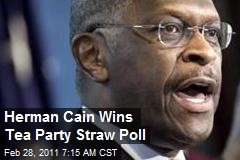
The Tea Partiers have lately favored Herman Cain's bid for president. They don't seem to care about Cain's skin color. They care that his 9-9-9 plan (a rather simplistic plan that would probably harm the interests of lower-income people with a national sales tax) is in line with their ideology.
By contrast, there has not been a big Occupy Wall Street protest anywhere in the country which has not had signs blaming the Jews for America's problems. For hundreds of years--all the way back to the time 1,000 years ago when the English kicked all of their Jewish citizens--the hatred of "the 1%" has been a hatred of the Jews. When people say they hate Wall Street or they hate big banks or they hate people with money, they are at the very least mimicking thousands of years of anti-Semitism, very often explicitly.
I am not saying that all people on the far left are anti-Semites. In fact, many of them are Jews. What I am saying is that this hatred of the people who work for or run banks or who trade bonds or who fund capital calls is right in the tradition of centuries of anti-Semitism. It is scapegoating "the other." It is blaming someone else, some minority, for your own problems.
Up until the 1960s, this sort of anti-Semitism in the United States was mostly the province of the right. But Malcolm X and later Louis Farrakhan made hatred of the Jews popular on the left.

If you find someone who hates Israel in the U.S., he almost certainly will be a left-winger, likely someone protesting today against Jewish bankers. Those who call themselves anti-Zionist never seem to cover their tracks to prove their hatred of Israel is not hatred of the Jews. They don't protest against maltreatment in the Middle East. You never see the so-called anti-Zionists in Davis protesting the inhumane governments of Syria or Iran. They never denounced Ghadhafi or Saddam Hussein. They instead have focused all of their hate on the Jews, protraying Israel as a bastion of evil.

It's funny, though, because Israel is the best country in the Middle East. It always has been. It is not perfect. It deserves criticism for many of its policies. But those doing the criticizing should also be critical of the far worse crimes against humanity committed by Hamas and Hezbollah and the Turkish government and god-forbid the brutal Saudi Arabian regime. The one country which has free speech and democratic elections and has a successful market economy and good schools and fair courts is the only one they hate? Yes, the anti-Zionist left is really just anti-Semitic.
Today in the L.A. Times it was reported that a woman who works for the L.A. Unified School District and is a protestor against the Wall Street Jews in Occupy Los Angeles was fired, after she called for Jews to be kicked out of the United States:
"I think that the Zionist Jews who are running these big banks and our Federal Reserve, which is not run by the federal government -- they need to be run out of this country," McAllister said in the video by Reason.tv, a Libertarian-leaning news organization.
Do you think anything this blatantly racist was ever spoken at a Tea Party rally?
I don't think the Occupy Wall Street movement of the left will amount to anything in our national politics, even though it seems to be very widespread. They don't really have any sound political ideas. They seem to just have this hatred for "the other." But if any of them are disturbed by the anti-Semitism of their movement, they owe it to our country and the sake of decency to stop tolerating so much anti-Semitism. They need to go to those sit-ins and carry a sign denouncing the hatred of the Jew.
Monday, October 10, 2011
What the water experts say:
I recently interviewed some UC Davis water experts regarding the sustainability of Davis continuing to draw its municipal water from wells, including the deep aquifer. Here is what I found out:
-----------

Richard Cowen, a professor emeritus in geology, told me: "A city the size of Davis (and it will increase in population) will locally deplete almost any aquifer. That will draw water inward to replace it. That situation can continue for a while, but in the end is not sustainable.
"The useful life span of a deeper aquifer depends on its geology and its source of recharge, neither of which I know. We are talking years rather than decades, I would imagine, without knowing the facts.
"Careful monitoring would give warning that an aquifer’s life is limited. But given the difficulty of finding an alternative, we might find ourselves in a bad bargaining position as time begins to run out. In other words, if we have a better alternative right now, why go to the trouble and expense of drilling into a new aquifer that has to be a diminishing resource?
"The Sacramento River is the biggest and cleanest water source in the region, and could certainly supply municipal water for Davis forever because its water is renewed from rain and snow every year. It would be much more reliable in the long term than any aquifer."
--------------

Gregory Pasternack, a professor of Watershed Hydrology in the Department of Land, Air and Water Resources, told me: "If you look at the facts on face value with no questioning of assumptions, then sure, Davis uses a lot of water and will be using ever more, so more supply and better supply is needed. A number of shallower wells in Davis are contaminated now and the good, deep aquifer varies in depth and water quality from East to West. Davis has spent a lot building one or more wells and then decommissioning without production due to manganese in the east, so that is a problem. The vision of getting high-quality surface water makes sense in that view. Deep groundwater can supply a lot, but do we really want to use that so heavily and ignore future generations? I think more deep groundwater wells would work for a while, as every community in the region is now probing for that same sweet spot at ~800-1000' depth."
"What bothers me is that we need to get serious about changing our water system more radically to get to where we need to go in terms of quality and quantity. If we were starting from scratch, we would never build the system like this, emptying all our best water onto lawns (or maybe they would, but shouldn't!). We would use low-quality water from shallower, cheap wells to irrigate, preserving the good, deep groundwater for household use only. Well, we are not starting from scratch, but the opportunity is here now just the same. We only get one shot to make this major investment in infrastructure, and what happens if the surface water conditions or water quality don't pan out over time due to climate change or legal rights issues? In fact, many neighborhoods have extensive greenbelts and buffer lands that could be used to run independent irrigation pipes OR we could open up the roads and run the pipes underground- just get it done one time and never have to worry about treating all that lawn water. Then retrofit the houses to take irrigation water from the new lines and leave the deep groundwater for household use."
-------------

Thomas Harter, a Cooperative Extension specialist in the Department of Land, Air and Water Resources and holder of the Robert M. Hagan Endowed Chair in Water Management and Policy, told me: "The issue, as I understand it, is not about the availability of groundwater, it is mostly about its quality and suitability a) for drinking and b) for meeting wastewater discharge requirements. I defer to the experts of Davis groundwater quality to speak to that topic and what future trends they may see. As to the question, whether groundwater will suddently change it's quality or will suddenly disappear in an unforeseen event - the answer depends on your perspective. Indeed, neither of these events will happen overnight or from one week to the next - the change is gradual. But when it takes a decade or more to develop an alternative water supply, "sudden" means: less than ten years. In that sense, we may indeed "suddenly" see changes that we cannot accurately predict today; water quality standards - which classify drinking water quality to be either "bad" or "good" may also change "suddenly", i.e., over the next decade. So, I do understand the need for planning ahead."
------------------

I asked Steve Grattan, a water specialist who studies "Salinity effects on plants at the plant and field scale; agricultural drainage water reuse and management; salinity-trace element interactions in plants; evapotranspiration" this:
Do you believe deep aquifer well water is a reliable, long-term source of water for Davis? Why or why not?
"This question is best answered by ground water hydrologists. However, my feeling is that if the Sacramento River is a viable option, the water will be of better quality than many of the ground water aquifers that supply the city of Davis. What is uncertain is the dependability on surface water supply over the long term. Certainly there will be continued droughts in California where various water users will compete for its (river) use. Another issue that needs to be considered is the gradual shift in peak water flows in many California rivers to earlier times. With climate change, not only is the snow pack in the Sierra Nevada mountains moving to higher elevations, snow melt is generally occuring earlier where peak flows are now occurring earlier in the year. This affects how much of this water is stored in dams vs how much is released down stream. With that trend, there may be merit in trying to re-capture that early flows in ground water aquifers by diverting it to flood plains. How this may affect water supplies for the city of Davis I am not sure but it is something important to consider."
If and when the deep aquifer dries up or no longer produces good water, will we have a number of years of advanced warning, or will we be shocked to find over night that we can no longer rely on our deep wells?
"If and when the deep aquifer dries up it will likely be a gradual process. It will not be something that happens over night. There will be a warning with sustained drop in aquifer depth over time. The water quality may also become progressively worse in quality over the years.
Based on what you know about the alternatives, would you recommend Davis go forward with its surface water project? Or do you think we are just as well off to wait 10 or 20 or more years before we spend the money it will take to bring Sacramento River water to Davis? Why or why not?
"It is never too early to begin to think about alternate water supplies. Ideally it would be valuable for the city of Davis if it had both sources available. The top priority would be Sacramento river water and during prolonged droughts, rely on ground water supplies. Ultimately it comes down to economics and water demand among the various water users."
-----------

By email, I asked Professor of Hydrogeology Graham Fogg if the deep aquifer was sustainable:
"This is poorly understood because of (a) the unknown future changes in groundwater quality due to downward movement of poor quality groundwater from agricultural and urban sources (Davis is not unique in this regard), (b) the unknown effects of increased pumping by the City in the so-called deep aquifer, from which UCD already withdraws drinking water, and (c) the unknown (to me at least) future demands for water in Davis when one considers growth and possible conservation measures. Of course, even if the groundwater quality continues to degrade, there is always the option of treating the groundwater to remove dissolved substances, much like we do routinely with surface water; but this costs."
How many years will the deep aquifer last?
"It's best to think of it as an "aquifer system" rather than an aquifer, because most of it consists of a complex network of aquifer materials (sands and gravels) and non-aquifer materials (silts and clays), and the latter are by far most prevalent. The groundwater levels appear to be recovering more or less fully every year following the dry season, indicating it is not yet in overdraft with respect to water quantity. In most any city where groundwater is the sole source of drinking water and landscape water, however, it is possible for demand to grow to the point that groundwater overdraft occurs. In that case, the aquifer system would not dry up and blow away, but there would be more severe restrictions on water use, like vastly reducing landscape watering, which is a large but non-essential part of the water demand. (I realize, it's an uphill battle in N. CA to get people more accustomed to lack of green grass, but since landscape watering in this part of the world is the largest part of the urban water budget, this issue will be receiving more and more attention.)
Will we have advanced warning before the aquifer dries up?
The changes in groundwater quality will not be sudden, but will likely continue on a decades to centuries time scale.
Do you believe that the Sacramento River water is a reliable and sufficiently safe long-term source for our municipal water?
Hydrologically, the Sacramento River water would be a reliable long term source. Legally, not sure because that is not my area of expertise.
Based on what you know about the alternatives, would you recommend Davis go forward with its surface water project?
"I am not sufficiently up to speed on the latest information (and related economics) to answer the big question. However, I would keep in mind the following guideposts:
"(a) The groundwater system is vulnerable due to long term degradation of water quality and potential for future overdraft. Many cities that rely solely on groundwater seem to eventually reach overdraft conditions.
"(b) Based on (a) and the water quality vulnerability, any planner in his right mind should jump at the chance to secure surface water sources that can be used in conjunction with the groundwater (i.e., use more of the surface water when you have it, keeping the groundwater in the 'bank'; use more of the groundwater during drought). Especially if that can be accomplished reasonably economically.
"(c) The common sense in (b) looks even better when you consider the wastewater discharge limitations that the Regional Board is apparently enforcing strictly. If the Board really will be requiring that Davis reduce drastically its salt load from wastewater discharged into the Delta watershed, then the only viable alternative I am aware of is for Davis to reduce the salt content in its drinking and landscape water by using substantially more Sac. R. water, which is much lower in dissolved salts.
"(d) The common sense in (b) also looks even better if the opportunity to secure the surface water is arising now and is unlikely to ever arise in the future.
"(e) The question probably hinges mostly on the wastewater discharge issue. If this will be strictly enforced, then Davis seems to have little alternative but to bring in more Sac. R. water if it can. If this discharge is not strictly enforced and never will be (big ifs), then Davis could probably make do just with groundwater. If they go groundwater only, then when the quality worsens, they will have to invest in water treatment in the coming decades. If and when they reach serious overdraft conditions, their only recourse would be to eliminate most lawn watering entirely. Such a measure would possibly be used to manage or reverse overdraft, but would require a major shift in attitudes of the citizenry."
----------------

I asked Qingfu Xiao, a research water scientist at UC Davis, if the deep aquifer was reliable:
"This is totally depends on how we (are) managing and using this resource. As more and more lands are used for buildings, streets, and parking lots, one problem, to make (the) deep aquifer well water reliable, is to use new technology and management to balance the groundwater withdraw and recharge. And the technologies are there at reasonable cost USGS has been testing recharge groundwater at relatively large scale in L.A."
How many years do you think deep aquifer water will last?
"It depends on how we pumping and recharging rate. It is a management issue. It will last longer than predicted because the fresh water line from Lake Berryessa (UCD), and water conservation from both technology and education."
Based on what you know about the alternatives, would you recommend Davis go forward with its surface water project?
"We should go forward with this surface water project. But, at the same time, we need rethink how we keep our groundwater system healthy, change our landscape design to increase groundwater recharge (water banking?). Multiple water resources will improve water quality and reliability for Davis."
-----------
Richard Cowen, a professor emeritus in geology, told me: "A city the size of Davis (and it will increase in population) will locally deplete almost any aquifer. That will draw water inward to replace it. That situation can continue for a while, but in the end is not sustainable.
"The useful life span of a deeper aquifer depends on its geology and its source of recharge, neither of which I know. We are talking years rather than decades, I would imagine, without knowing the facts.
"Careful monitoring would give warning that an aquifer’s life is limited. But given the difficulty of finding an alternative, we might find ourselves in a bad bargaining position as time begins to run out. In other words, if we have a better alternative right now, why go to the trouble and expense of drilling into a new aquifer that has to be a diminishing resource?
"The Sacramento River is the biggest and cleanest water source in the region, and could certainly supply municipal water for Davis forever because its water is renewed from rain and snow every year. It would be much more reliable in the long term than any aquifer."
--------------

Gregory Pasternack, a professor of Watershed Hydrology in the Department of Land, Air and Water Resources, told me: "If you look at the facts on face value with no questioning of assumptions, then sure, Davis uses a lot of water and will be using ever more, so more supply and better supply is needed. A number of shallower wells in Davis are contaminated now and the good, deep aquifer varies in depth and water quality from East to West. Davis has spent a lot building one or more wells and then decommissioning without production due to manganese in the east, so that is a problem. The vision of getting high-quality surface water makes sense in that view. Deep groundwater can supply a lot, but do we really want to use that so heavily and ignore future generations? I think more deep groundwater wells would work for a while, as every community in the region is now probing for that same sweet spot at ~800-1000' depth."
"What bothers me is that we need to get serious about changing our water system more radically to get to where we need to go in terms of quality and quantity. If we were starting from scratch, we would never build the system like this, emptying all our best water onto lawns (or maybe they would, but shouldn't!). We would use low-quality water from shallower, cheap wells to irrigate, preserving the good, deep groundwater for household use only. Well, we are not starting from scratch, but the opportunity is here now just the same. We only get one shot to make this major investment in infrastructure, and what happens if the surface water conditions or water quality don't pan out over time due to climate change or legal rights issues? In fact, many neighborhoods have extensive greenbelts and buffer lands that could be used to run independent irrigation pipes OR we could open up the roads and run the pipes underground- just get it done one time and never have to worry about treating all that lawn water. Then retrofit the houses to take irrigation water from the new lines and leave the deep groundwater for household use."
-------------

Thomas Harter, a Cooperative Extension specialist in the Department of Land, Air and Water Resources and holder of the Robert M. Hagan Endowed Chair in Water Management and Policy, told me: "The issue, as I understand it, is not about the availability of groundwater, it is mostly about its quality and suitability a) for drinking and b) for meeting wastewater discharge requirements. I defer to the experts of Davis groundwater quality to speak to that topic and what future trends they may see. As to the question, whether groundwater will suddently change it's quality or will suddenly disappear in an unforeseen event - the answer depends on your perspective. Indeed, neither of these events will happen overnight or from one week to the next - the change is gradual. But when it takes a decade or more to develop an alternative water supply, "sudden" means: less than ten years. In that sense, we may indeed "suddenly" see changes that we cannot accurately predict today; water quality standards - which classify drinking water quality to be either "bad" or "good" may also change "suddenly", i.e., over the next decade. So, I do understand the need for planning ahead."
------------------

I asked Steve Grattan, a water specialist who studies "Salinity effects on plants at the plant and field scale; agricultural drainage water reuse and management; salinity-trace element interactions in plants; evapotranspiration" this:
Do you believe deep aquifer well water is a reliable, long-term source of water for Davis? Why or why not?
"This question is best answered by ground water hydrologists. However, my feeling is that if the Sacramento River is a viable option, the water will be of better quality than many of the ground water aquifers that supply the city of Davis. What is uncertain is the dependability on surface water supply over the long term. Certainly there will be continued droughts in California where various water users will compete for its (river) use. Another issue that needs to be considered is the gradual shift in peak water flows in many California rivers to earlier times. With climate change, not only is the snow pack in the Sierra Nevada mountains moving to higher elevations, snow melt is generally occuring earlier where peak flows are now occurring earlier in the year. This affects how much of this water is stored in dams vs how much is released down stream. With that trend, there may be merit in trying to re-capture that early flows in ground water aquifers by diverting it to flood plains. How this may affect water supplies for the city of Davis I am not sure but it is something important to consider."
If and when the deep aquifer dries up or no longer produces good water, will we have a number of years of advanced warning, or will we be shocked to find over night that we can no longer rely on our deep wells?
"If and when the deep aquifer dries up it will likely be a gradual process. It will not be something that happens over night. There will be a warning with sustained drop in aquifer depth over time. The water quality may also become progressively worse in quality over the years.
Based on what you know about the alternatives, would you recommend Davis go forward with its surface water project? Or do you think we are just as well off to wait 10 or 20 or more years before we spend the money it will take to bring Sacramento River water to Davis? Why or why not?
"It is never too early to begin to think about alternate water supplies. Ideally it would be valuable for the city of Davis if it had both sources available. The top priority would be Sacramento river water and during prolonged droughts, rely on ground water supplies. Ultimately it comes down to economics and water demand among the various water users."
-----------

By email, I asked Professor of Hydrogeology Graham Fogg if the deep aquifer was sustainable:
"This is poorly understood because of (a) the unknown future changes in groundwater quality due to downward movement of poor quality groundwater from agricultural and urban sources (Davis is not unique in this regard), (b) the unknown effects of increased pumping by the City in the so-called deep aquifer, from which UCD already withdraws drinking water, and (c) the unknown (to me at least) future demands for water in Davis when one considers growth and possible conservation measures. Of course, even if the groundwater quality continues to degrade, there is always the option of treating the groundwater to remove dissolved substances, much like we do routinely with surface water; but this costs."
How many years will the deep aquifer last?
"It's best to think of it as an "aquifer system" rather than an aquifer, because most of it consists of a complex network of aquifer materials (sands and gravels) and non-aquifer materials (silts and clays), and the latter are by far most prevalent. The groundwater levels appear to be recovering more or less fully every year following the dry season, indicating it is not yet in overdraft with respect to water quantity. In most any city where groundwater is the sole source of drinking water and landscape water, however, it is possible for demand to grow to the point that groundwater overdraft occurs. In that case, the aquifer system would not dry up and blow away, but there would be more severe restrictions on water use, like vastly reducing landscape watering, which is a large but non-essential part of the water demand. (I realize, it's an uphill battle in N. CA to get people more accustomed to lack of green grass, but since landscape watering in this part of the world is the largest part of the urban water budget, this issue will be receiving more and more attention.)
Will we have advanced warning before the aquifer dries up?
The changes in groundwater quality will not be sudden, but will likely continue on a decades to centuries time scale.
Do you believe that the Sacramento River water is a reliable and sufficiently safe long-term source for our municipal water?
Hydrologically, the Sacramento River water would be a reliable long term source. Legally, not sure because that is not my area of expertise.
Based on what you know about the alternatives, would you recommend Davis go forward with its surface water project?
"I am not sufficiently up to speed on the latest information (and related economics) to answer the big question. However, I would keep in mind the following guideposts:
"(a) The groundwater system is vulnerable due to long term degradation of water quality and potential for future overdraft. Many cities that rely solely on groundwater seem to eventually reach overdraft conditions.
"(b) Based on (a) and the water quality vulnerability, any planner in his right mind should jump at the chance to secure surface water sources that can be used in conjunction with the groundwater (i.e., use more of the surface water when you have it, keeping the groundwater in the 'bank'; use more of the groundwater during drought). Especially if that can be accomplished reasonably economically.
"(c) The common sense in (b) looks even better when you consider the wastewater discharge limitations that the Regional Board is apparently enforcing strictly. If the Board really will be requiring that Davis reduce drastically its salt load from wastewater discharged into the Delta watershed, then the only viable alternative I am aware of is for Davis to reduce the salt content in its drinking and landscape water by using substantially more Sac. R. water, which is much lower in dissolved salts.
"(d) The common sense in (b) also looks even better if the opportunity to secure the surface water is arising now and is unlikely to ever arise in the future.
"(e) The question probably hinges mostly on the wastewater discharge issue. If this will be strictly enforced, then Davis seems to have little alternative but to bring in more Sac. R. water if it can. If this discharge is not strictly enforced and never will be (big ifs), then Davis could probably make do just with groundwater. If they go groundwater only, then when the quality worsens, they will have to invest in water treatment in the coming decades. If and when they reach serious overdraft conditions, their only recourse would be to eliminate most lawn watering entirely. Such a measure would possibly be used to manage or reverse overdraft, but would require a major shift in attitudes of the citizenry."
----------------

I asked Qingfu Xiao, a research water scientist at UC Davis, if the deep aquifer was reliable:
"This is totally depends on how we (are) managing and using this resource. As more and more lands are used for buildings, streets, and parking lots, one problem, to make (the) deep aquifer well water reliable, is to use new technology and management to balance the groundwater withdraw and recharge. And the technologies are there at reasonable cost USGS has been testing recharge groundwater at relatively large scale in L.A."
How many years do you think deep aquifer water will last?
"It depends on how we pumping and recharging rate. It is a management issue. It will last longer than predicted because the fresh water line from Lake Berryessa (UCD), and water conservation from both technology and education."
Based on what you know about the alternatives, would you recommend Davis go forward with its surface water project?
"We should go forward with this surface water project. But, at the same time, we need rethink how we keep our groundwater system healthy, change our landscape design to increase groundwater recharge (water banking?). Multiple water resources will improve water quality and reliability for Davis."
Monday, June 13, 2011
America is happy: good triumphed over evil: the Mavericks beat the Heat: Dirk is a champ; LeBron is a chump

Outside of South Florida, all of America is happy. The lovable Mavericks defeated the hated Heat in 6 games, winning the NBA Championship.
There has been much speculation as to why America was rooting for Dallas, and why America so hates LeBron James. Most of the talk centers around "The Decision," where LeBron held a one hour interview on live TV in order to announce last summer that he was going to sign a free agent contract with the Miami Heat.
That is part of the reason no one but Heat fans wanted to see LeBron win. But it's not the biggest reason. Here, then, are the top 10 reasons why America rooted for Dallas and against Miami in the NBA Championships:
1. The spurned woman syndrome. LeBron James grew up near Cleveland in Akron, Ohio. LeBron never had another girlfriend in the pros. He was married to Cleveland. He had played his entire career with the Cavaliers. Cleveland had been a good and loving wife. Cleveland did everything in her powers to make LeBron happy. Cleveland paid LeBron the top salary possible. Cleveland tried everything it could to acquire good players around LeBron to help him win a ring. Yet the second a prettier girl shook her hips in LeBron’s direction, he fell for the bait. He left his loyal wife for a younger, sexier model named Miami. No one loves the man who quits on his loyal wife. We identify with the spurned woman.
2. Cleveland as an underdog. It is not just the case that Cleveland has a poor economy, bad weather and miserable people. It’s that Cleveland never has had much luck with its pro sports teams. The Indians had a few good teams in the 1990s, but they haven’t won since the 1950s. And the Browns, ever since the great Jim Brown retired in the 1960s, have been a perennial loser, almost always finishing with a losing record. But that bad luck seemed to have turned around with the arrival of LeBron James. He took them to the Finals a few years ago; and each of his last 4 years in Cleveland had made the Cavaliers one of the best teams in the NBA. It seemed like just a matter of time before the Cavs would finally win it all. But then LeBron bolted. By quitting on them, he took away that hope for that underdog city.
3. The Decision as a shocker. It makes for much better theater when you have a drama and you don’t know the outcome. So give LeBron credit for not spilling the beans in advance of his announcement that he was going to play for Miami. But because no word had leaked out, just about everyone thought this was all a big show about nothing—that he would remain with the Cavaliers. So the shock was all that much worse when he announced he was quitting on his team, his city, and his fans. The second we collectively recovered from LeBron's sucker punch, the shock turned to anger, hurt and disappointment.
4. The Decision as egotism + The Miami Dance Party. It’s hard not to be an egoist when you have the god-given gifts of LeBron James. That said, he came across as terribly arrogant when he stated, “I am taking my talents to South Beach.” Never mind that the Heat play in Miami, not South Beach, which is in a different city (Miami Beach). The fact that he referred to his “talents” in the third person made it sound as if he pictured himself as above a human being, that he carried around this amazement known as his “talents.” Add to that the egoism of the celebration held in Miami before the season in which LeBron and his new mates danced and laughed and proclaimed they would win 8 championships as a group. That is hard to like when LeBron had never won anything.
5. The Conspiracy. The fact that LeBron, Dwyane Wade and Chris Bosh, all of whom played together on Team USA conspired well in advance of their free agency to form a super team in the NBA makes this Miami Heat group feel inorganic. It’s not that they are a super team. The Lakers are a super team. The Celtics are another. There have been many past teams which had multiple superstars in their primes at the same time. But unlike all of those who came before this Heat team, the others were formed one piece at a time by the draft, by a trade or by adding a single free agent. In this case, it was clear that the Team USA teammates went around the traditional system. They took charge. They created this Miami Heat super team. And the team feels inauthentic for it.
6. Dallas as an underdog. The Mavericks have been around as an expansion team since the 1980-81 season. Yet they had never won a championship. Everyone loves the underdog. Everyone will keep on loving Dallas, unless they hurt us by continuing to win. Then they will be an overdog.

7. Dirk Nowitzki as an underdog. Dirk has been viewed for a long time as a very good, yet somewhat soft Euro. He’s a 7-foot tall man, yet all he seemed able to do was shoot from the outside. But after 13 years in the NBA, after progressively getting better, developing toughness, playing better team defense, learning how to drive to the basket and post up, and learning how to take charge of his team and to command respect from his opponents, his story arc is one fans can identify with. He overcame his own faults and worked and worked until he was good enough to win. Unlike LeBron, he was never handed the expectations of being an all-time great. He just made himself into one.
8. Race, but not racism. The fact that Dirk Nowitzki, the best player on Dallas, is white and that whites are generally bad at basketball compared with blacks, makes any great white player an anomaly and to that extent an underdog. As such, all very good white players tend to get overrated and over-loved in the NBA. If half the league were white, no one would care. But because 85% of the league is black and because 95 percent of the greatest players of all time are black makes the fans, who are naturally drawn to the underdog, root for the rare good white guy. This may sound like white racism. However, I think it is the same thing in other sports where most of the athletes are white and the black star is rare. In hockey, the few great black players get extra love for it. The same is true with black golfers, white sprinters in track, black swimmers, black skiers, etc.
9. The other Mavericks. Jason Kidd, for one, has been in the league a long time. He is one of the best point guards of all time. He will be in the Hall of Fame. Yet he had never before won a ring. Another is JJ Barea, a little man who came up big time and again in this post-season. I think people are happy for Jason Terry, who started out playing poorly but improved as the series went on and was the best player on the court in the final game.

10. The ugly factor. LeBron is not a good looking man. I don't think anyone hates him for that. However, his ugly face makes it easier to see him in the role of a villain. The same could never be said about Michael Jordan, who was born with good looks and loads of talent.
Tuesday, May 24, 2011
Would it be so wrong to appoint a person to replace Gabby Giffords in Congress until she is well enough to do the job?

The AP is reporting that Gabby Giffords is back in the hospital following her most recent surgery:
U.S. Rep. Gabrielle Giffords has been transferred back to her rehabilitation hospital in Houston after recovering from last week's surgery at a nearby hospital.
The 40-year-old Arizona Democrat had been recuperating at Memorial Hermann-Texas Medical Center since last Wednesday's surgery to implant a synthetic replacement for a portion of her skull. Doctors also gave Giffords a permanent shunt to relieve fluid buildup in her brain.
Part of Giffords' skull was removed Jan. 8, the same day she was shot in the head in a shooting in Tucson that left six dead and 12 others wounded.
While I am terribly sympathetic to Ms. Giffords and hope for the best for her recovery, I have been thinking lately about how unrepresented the people of her Congressional district have been since Giffords was attacked in that Safeway parking lot.
I think we need a better way to deal with a member of Congress who has become temporarily (or possibly permanently) incapacitated: the governor of her state should be authorized to appoint an interim member who would serve in her place until the Congresswoman has healed or her term expires.
It would be unfair to Giffords to remove her from office in this case. She was duly elected. But it is unfair to her district to have no representation in Congress for nearly 2 years.
I recognize that the Arizona governor is a Republican and Ms. Giffords is a Democrat. So perhaps the fairest choice would be to allow the head of the Democrats in the state legislature to have a veto over the interim appointee. That would hopefully mean the person chosen was agreeable to all parties for the time being.
Monday, April 25, 2011
Judge Rosenberg claims my column was “full of misstatements and misconceptions.”

In the April 26 edition of The Davis Enterprise, an op-ed penned by Yolo County Judge David Rosenberg will be published. Judge Rosenberg’s piece, which is now available in the online edition of the newspaper, is an attack on my April 13 column which questioned whether now is the right time to be spending $5 billion on 41 courthouse projects, one of which will be built in Woodland.
New Yolo courthouse will benefit residents
By David Rosenberg
Under the headline “Courthouse plans straining budget,” your columnist Rich Rifkin (April 13) challenged the new Yolo courthouse project. His column is so full of misstatements and misconceptions that I felt compelled to respond.
As a public service, I will count up every misstatement and every misconception I made.
In fact, a new courthouse project was approved (years ago) for Yolo County, costing about $173 million. The land already has been identified and acquired, the design phase is now under way, leading to the start of construction, hopefully, at some point next year.
So far, Judge Rosenberg has failed to point out a single misstatement or misconception of mine.
However, even the headline of Rifkin’s column is inaccurate.
The judge should know that I have nothing to do with the headlines. Those are written by the editors. That qualifies as the first misconception in this exchange.
Rosenberg 1-0 in misconceptions.
This project is not straining any budget — state, county or local.
I never stated in any way that this project is straining any budget. That counts as a second misconception for the man who worked so hard to get a public skate park built in Davis.
Rosenberg 2-0.
Not one penny of taxpayer money is used for the courthouse project.
I never said the 41 courthouse projects would be funded by a tax. I explained carefully in my piece how a new fee would be attached to all parking tickets, moving violations and other criminal convictions in which the convicted is not sent to prison.
I won’t charge Judge Rosenberg for a third misconception, here. Rather, I will charge him with a blatant deception. His effort is to mislead his readers, making them think I wrote incorrectly how the funds for his courthouse will be generated.
Rosenberg 2-0 in misconceptions plus one deception.
No state general fund money is used for the project.
Again, I never stated that any general fund money would be used. That counts as deception number two for Dave.
Rosenberg 2-0 in misconceptions plus two deceptions.
The project is completely funded by a statewide surcharge assessed against everyone convicted of a violation of the criminal law.
I think this statement qualifies as deception number three and misstatement number one for Yolo County’s presiding judge. He misleads his readers with “a violation of the criminal law,” because almost all of the money will come from traffic offenders and parking violations. And because, when a person is sent to prison (see EDIT 1) he normally does not pay the fee but works it off, Judge Rosenberg knows that it is not “everyone convicted” who will pay this surcharge.
Misconceptions: 2-0; Deceptions: 2-0. Misstatements: 1-0.
Rifkin’s column asserts that the money for the new courthouse could better be used elsewhere.
It could be better used elsewhere at this time. What I wrote was that until we are out of the economic and budget crisis, we should put off funding luxurious courthouses like the one planned for Woodland.
He says “with that much largesse, Yolo County could pay off almost all of its $175.5 million unfunded pension liability to the miscellaneous employees.” Interesting theory.
Thanks for your interest in my theory, Dave.
But Rifkin ignores several facts.
Let’s hear your facts, your honor.
First, to do so would violate state law, which requires that the money collected from people who violate the law should be used for court facilities.
I did not ignore that “fact,” Davey! I suggested that the Legislature change the law. I noted, “…there is no reason SB 1407 could not be temporarily changed.”
Misconceptions: 2-0; Deceptions: 2-0. Misstatements: 2-0.
Second, to do so would ignore the constitution, which would mandate some sort of nexus between the fee and the expenditure — using the funds from those convicted of crime to pay off a county’s debt has no nexus; using the funds to pay for court facilities certainly does.
I never said these fees should be used to pay off the county's debt. I merely noted that the amount that Yolo County's pension funding for its miscellaneous employees is short is nearly identical to the amount the new courthouse would cost. In other words, if Yolo County had this money, it could pay off this debt.
It’s hard for me, a layman, to argue the state constitution with a superior court judge. However, I believe the judge knows he is being duplicitous, here. He admitted as much some paragraphs down when he wrote this:
“Rifkin fails to mention that the state Legislature last year borrowed a substantial portion of this fund for ‘other purposes’ and is poised to divert a substantial amount of this fund again this year.”
So which is it, judge? You state that the money cannot be used for other purposes, and then you state that the money is being used for other purposes. Is your left brain not communicating well with your right brain? Or are you just trying to deceive your readers?
Misconceptions: 2-0; Deceptions: 3-0. Misstatements: 2-0.
Finally, pursuing Rifkin’s “logic” to the ultimate conclusion, government should not pay for capital projects but should divert its money to pay for debt service or operations.
Once again, this public servant is trying to deceive his readers. Either that, or he just did not read my column carefully.
I never mentioned anything about not paying for capital projects. I never even said the judge’s shiny new courthouse project should be abandoned. I simply suggested that while we are in a severe budget crisis, it is questionable in my mind whether now is the best time to be spending this $5 billion it will cost to build 41 courthouse projects, 35 of which are brand new buildings.
Misconceptions: 2-0; Deceptions: 4-0. Misstatements: 2-0.
I suppose the city of Davis should not have built or repaired roads, or parks or pools, or the Veterans’ Memorial Center or the Senior Center — per Rifkin, the money would have been better spent in operations.
The judge seems to have no factual points to make. So instead he just makes up shinola like this. The fact is that I don’t object to roads or public buildings. I simply argued in my column that while the state is drowning in red ink, it would be a good idea to put off this $5 billion expenditure.
Misconceptions: 2-0; Deceptions: 4-0. Misstatements: 3-0.
The reality is that it is never easy to accommodate long-range projects such as roads, bridges, canals or buildings.
Actually, the judge is wrong here. It’s not that hard. Our state has passed scores of bond measures to fund these sorts of projects. Since 1996, we have approved more than $21 billion in general obligation bonds. For details, see what the Legislative Analyst’s office reports.
Misconceptions: 2-0; Deceptions: 4-0. Misstatements: 4-0.
The immediate demands for operations are always great. Kudos to the governor, the Legislature and the judicial branch for recognizing this and for creating a logical funding source for new courthouses in California: a fee charged only to persons convicted of crimes. Who better to pay for court facilities?
Repeating himself, as the judge is wont to do, Rosenberg states that these courthouse buildings will be paid for by convicted criminals. He conveniently fails to mention that almost all of the money will be generated by a large surcharge on traffic tickets and a smaller charge tacked on parking tickets.
Do you wonder why the judge didn’t explain that in his tirade?
Misconceptions: 2-0; Deceptions: 5-0. Misstatements: 4-0.
Rifkin goes on to say that Davis City Councilwoman Sue Greenwald mentioned to him that the price of the new Yolo courthouse is almost three times the price of the “luxurious” Mondavi Center. But surely Greenwald and Rifkin understand that a courthouse is not a theater.
A courthouse is not a theater? Thanks for letting me in on that, your honor.
A courthouse is a complex structure, unlike any other building. The current Yolo courthouse facilities see more than 300,000 separate trips of users and visitors each year.
That’s another way of saying about 1,000 people each day go into our courthouse. I wonder how that compares with the foot traffic in a typical big box store?
A courthouse has special security needs, the requirement for three separate pathways (for the public, for in-custody defendants, and for judicial officers and staff), unique courtrooms, public-serving counters, jury assembly space, holding cells, interview rooms and numerous other requirements.
Further, the new Yolo courthouse will be a LEED-certified (Leadership in Energy and Environmental Design) building, using the latest energy-saving technologies.
I wonder how many times in this column Judge Rosenberg will tell us that the new courthouse building will be LEED certified? I think LEED certification can be a nice thing. The new Target is LEED certified.
As an aside, there are a lot of environmentalists who are critical of LEED certifications. The famed architect Frank Gehry, who designed the purposefully weird Guggenheim Museum in Bilbao, has, for example, said that LEED certification is often given for “bogus stuff.” I never charged that Rosenberg’s building will be given LEED points for bogus stuff.
Certainly, $173 million is a great deal of money — but it is what it costs to build a courthouse. The new courthouse planned for Sacramento County is pegged at about $510 million.
The judge likely read that in my column, where I noted that the “new 35-courtroom Sacramento Criminal Courthouse is slated to cost $509 million.” Maybe he wants you to think the $172.9 million project in Woodland is cheap by comparison?
The main thrust of Rifkin’s column is that in these difficult times, the money for courthouse construction could be better spent by being diverted for other purposes.
That was my main point, judge. I am glad to see you understood what I said.
Whether true or not, Rifkin fails to mention that the state Legislature last year borrowed a substantial portion of this fund for “other purposes” and is poised to divert a substantial amount of this fund again this year.
Recall that a few paragraphs up, Judge Rosenberg, who is an expert on the constitution, said this could not be done. Have you decided, Dave, which way is it?
So, clearly, the Legislature — which thrashes around for available pots of money in difficult times — has, in fact, diverted courthouse construction funds for “other purposes” already.
Good. I thought you told me that was unconstitutional. I guess you were thinking of some other state constitution when you wrote that.
Misconceptions: 2-0; Deceptions: 6-0. Misstatements: 4-0.
Fortunately, the Yolo courthouse project is so high on the list of critical projects that it will (sic) unaffected by this diversion.
It looks like no one edited Rosenberg’s writing. Not only does it have grammatical errors (“will unaffected”), but no one pointed out to the judge that he repeats his points again and again.
Rifkin’s column then goes on to denigrate courthouse projects as “Taj Mahals.” That is inaccurate and unfair.
How is that a denigration? The Taj Mahal is fabulous. Wikipedia says, “It is widely considered as one of the most beautiful buildings in the world and stands as a symbol of eternal love.”
Misconceptions: 2-0; Deceptions: 6-0. Misstatements: 5-0.
Courthouses are important public buildings that last many generations. The current historic courthouse in Yolo County has lasted almost a century. The new Yolo courthouse will be a courthouse for the next hundred years.
I have not seen any architectural renderings for the new Rosenberg courthouse. However, my guess is that it will feature a lot of high end décor. If it doesn’t, I will gladly buy Dave a coffee in downtown Woodland.
It will not be an insubstantial building — it will house 14 courtrooms, a jury assembly area to accommodate more than 300 prospective jurors, clerks’ offices and counters for the public, holding cells for in-custody defendants, security stations and many other features unique to courthouses.
Did you say it will house 14 courtrooms?
In addition, the new courthouse will be a LEED building, built to the best standards of environmental efficiency that we can muster.
Wait a minute, Dave. Didn’t you already brag that it will be a LEED building? Is it not against the law in Woodland to repeat yourself in your same column?
The Yolo court facilities are among the busiest — perhaps the busiest — public buildings in the county.
Maybe that’s because our district attorney has a tendency to bring every possible case to trial, rather than reach plea agreements with defendants? I don’t know if that is true. However, I have read that argument in a widely read Davis blog.
Rifkin’s criticism even goes so far as to challenge the five-story projection for the new courthouse.
Goes so far as to challenge? I stated its height as a matter of fact: “The five-story project will house 14 new courtrooms, each twice the size of the courtrooms in the historic edifice on Court Street.”
Misconceptions: 3-0; Deceptions: 6-0. Misstatements: 5-0.
Five stories, while clearly substantial, will not be out of place on Main Street in downtown Woodland.
I never said it would be out of place.
The historic Hotel Woodland — just down the street from the proposed courthouse — has four stories and roof facades.
As it happens, the Hotel Woodland is more than five blocks from where the Rosenberg Courthouse will be erected. Most of the existing structures adjacent to the block between Lincoln and Main and Fifth and Sixth streets, where the courthouse will be, are one story tall.
Misconceptions: 3-0; Deceptions: 7-0. Misstatements: 5-0.
The current historic courthouse on Court Street has four stories. There is a processing plant on Main Street just four blocks east of the proposed courthouse that is more than five stories in height.
The point is that the new courthouse must hold 14 courtrooms and attendant court uses.
You say it will house 14 courtrooms?
While the courthouse could be four stories, or even three stories, that would be poor planning. A shorter courthouse would have a larger footprint, taking much more of the land and thus restricting future expansion in 10 or 20 years.
The judge claimed above he is building this structure to last 100 years. Now he says in 10 or 20 years he wants it built even larger? Which is it, Dave?
Misconceptions: 4-0; Deceptions: 7-0. Misstatements: 5-0.
One problem with state buildings is that the state builds only for today’s needs, not for tomorrow’s requirements. The current needs for Yolo County are 14 courtrooms.
You say it will house 14 courtrooms?
In 10 years we will need more. By using less of the land, the court has the ability to expand on site.
Maybe instead of spending a lot more money in 10 years, we can make use of the historic courthouse on Main Street a decade from now?
Rifkin then criticizes the 14 courtrooms planned in the new courthouse by asserting that each will be twice the size of the current courtrooms.
I never criticized that. I merely pointed it out: “The five-story project will house 14 new courtrooms, each twice the size of the courtrooms in the historic edifice on Court Street.”
It is apparent that the judge has poor judgment when deciphering between a criticism and a statement of fact.
Misconceptions: 3-0; Deceptions: 6-0. Misstatements: 6-0.
It is certainly correct that the new courtrooms will be twice the size of current courtrooms.
He even agrees with me! Wait! I thought he said my column was full of misstatements. Maybe that was just the judge exercising poor judgment?
But what Rifkin fails to say is that current courtrooms are less than half the size of a standard California courtroom per state minimum standards.
This is circular logic, your honor. You and your fellow judges arbitrarily decide what the standard is, and then you declare our courtrooms fail to meet that standard. What I wonder is, what percentage of cases tried in our current Yolo County Courthouse must be moved to other facilities because the current courtrooms are too small? If it is greater than 1 percent, I will buy Judge Rosenberg a second cup of coffee in downtown Woodland.
Our current courtrooms were built in prior generations — our historic courthouse was built to house two courtrooms and we currently have eight courtrooms shoehorned into the building. We have two courtrooms in trailers, and others in rented buildings and in converted holding areas.
That’s a fine argument that at some point we need a new courthouse facility. I have not challenged that. I have simply questioned why, when the state is more than $15 billion in the red, we can’t put off this $5 billion, 41 courthouse program for a few years?
When the new courthouse is built, Yolo County will finally have standard-size courtrooms like other counties in the state.
Is that really what is bothering you? That other counties have bigger and better courtrooms than you have? Shouldn’t you be explaining how many trials had to be moved out of our county because our courtrooms are too small?
The need for a new Yolo County Courthouse is manifest. Our current facilities are scattered throughout the city of Woodland. The historic courthouse is ancient, and seismically unsafe.
You say it is seismically unsafe? Really?
Maybe you meant to say that it does not meet current seismic safety standards in California. But that certainly does not mean it is not structurally sound enough to survive the tremors that hit Woodland.(Note: there are no worrisome fault lines in or around Woodland. The closest faults are in the Capay Valley)
Misconceptions: 3-0; Deceptions: 6-0. Misstatements: 7-0.
Every single one of the existing courtrooms is substandard.
Yet they do not seem to be obstructing justice in Yolo County at the moment. As such, waiting a few more years until our economy recovers and the state’s fiscal crisis is resolved would not hurt anyone (other than a few judges who want nicer digs right away).
We have inadequate space for jurors, who often have to sit on stairways. We have no space for children. The wiring, plumbing and electrical systems are ancient. Hallways are shared by in-custody defendants, witnesses, victims, jurors, members of the public, judges and staff. It is truly medieval.
Truly medieval? Medieval times ended in the mid-1400s, before Christopher Columbus sailed to the Americas. You must have meant to say the historic courthouse is truly Wilsonian. It was erected in 1917.
Misconceptions: 3-0; Deceptions: 6-0. Misstatements: 8-0.
That’s why Yolo wound up at the very top of the food chain in terms of critical needs for a new state-of-the-art courthouse. The citizens of Yolo County deserve no less.
You don’t mean to say, the court employees and judges deserve no less?
At the beginning of his piece, Judge Rosenberg claimed my column was “full of misstatements and misconceptions.” He never once pointed out a single misstatement or misconception of mine. Yet his op-ed was riddled with errors, each of which I noted above. It is sad that a public servant like Judge Rosenberg feels compelled to attack my work with so little regard for honest argument. He restated many of his points, simply because he had so little of worth to state. He had no direct refutation of anything I wrote. I feel embarrassed for the judge for having submitted this piece of drivel. It makes him look small.
----------------------------
 EDIT 1: David Greenwald of the Davis Vanguard explained to me that the fee is not waived when a person is sent to prison. Rather, he said, the criminal must work off his fee in that case.
However, some court fees may be waived by a judge due to financial hardship. See Court Rule 3.50 to 3.58:
The rules in this division govern applications in the trial court for an initial waiver of court fees and costs because of the applicant’s financial condition. As provided in Government Code sections 68631 and following, any waiver may later be ended, modified, or retroactively withdrawn if the court determines that the applicant is not eligible for the waiver.
EDIT 2: Here are the six new fees imposed by SB 1407:
1. Proof of correction fee, $25 -- This fee is now collected per citation. Effective January 1, 2009, the fee will be collected per correction. $15 on the first correction and $25 on any additional corrections on the citation are remitted to SCFCF - ICNA.
2. Traffic violator school fee, $49 -- 51% of fee collected remitted to SCFCF - ICNA.
3. Criminal conviction assessment, $35 -- $35 remitted to SCFCF - ICNA.
4. Criminal conviction assessment, $30 -- $30 remitted to SCFCF - ICNA.
5. State court construction penalty, $5 -- Increase remitted to SCFCF - ICNA.
6. State court construction parking penalty, $4.50 -- $3 remitted to SCFCF - ICNA.
Thursday, April 21, 2011
One artsy gang banger ...

The people who say, "truth is stranger than fiction," just don't read much fiction. But once in a while, the truth is as hard to believe as fiction.
If I saw a crime drama on TV in which a murderer confessed to his crime by having his chest tattooed with all of the details of the murder, I would find that hard to believe.
If additionally the homicide investigator who discovered the tattooed man with all the details of his crime depicted on his chest only knew the details of that murder because before he was promoted to his new position he had been a beat cop in the exact neighborhood this strange killing took place, I would find that an incredible coincidence.
Yet apparently in the Pico Rivera section of Mexican L.A., there is just such a stupid killer and just such a lucky cop. This is from the L.A. Times story:
The process was routine. L.A. County Sheriff's homicide investigator Kevin Lloyd was flipping through snapshots of tattooed gang members.
Then one caught his attention.
Inked on the pudgy chest of a young Pico Rivera gangster who had been picked up and released on a minor offense was the scene of a 2004 liquor store slaying that had stumped Lloyd for more than four years.
Each key detail was right there: the Christmas lights that lined the roof of the liquor store where 23-year-old John Juarez was gunned down, the direction his body fell, the bowed street lamp across the way and the street sign — all under the chilling banner of RIVERA KILLS, a reference to the gang Rivera-13.
As if to seal the deal, below the collarbone of the gang member known by the alias "Chopper" was a miniature helicopter raining down bullets on the scene.
Lloyd's discovery of the tattoo in 2008 launched a bizarre investigation that soon led to Anthony Garcia's arrest for the shooting.
Wednesday, April 13, 2011
Teachers need to be paid based on their performance, not on seniority

The L.A. Times reports today that the L.A. Unified School District is moving in the right direction, but in my view that district still has not yet gone far enough:
In a dramatic turn for the country's second-largest school district, Los Angeles Unified released school ratings based on a new approach that measures a school's success at raising student performance — the first in a series of high-stakes moves that will thrust the district into the center of the national debate over education reform.
Next month, the district will take the more controversial step of providing thousands of teachers with confidential ratings of their performance using the same approach, known as value-added. The district is also negotiating with the teachers union to include such measures in teachers' formal performance reviews, an effort the union bitterly opposes.
Along with some peer-review and the judgment of a school principal, how much progress a teacher's students make should determine how much the teacher is paid.
The new measure of academic success has been a top priority for incoming Supt. John Deasy, who formally takes over Friday. It comes as districts throughout the country are wrestling with the reliability and the proper use of the value-added approach, which estimates school and teacher performance by analyzing students' improvement on standardized tests in math and English.
There are, of course, some subjects, like art or music, where measuring student progress objectively is difficult. In those cases, peer-review and the judgment of the principal should decide how good the teacher is.
The district has had the data to conduct its own analysis for years but had never done so. Officials have said their adoption of the approach was hastened by a Times series and database released in August that rated elementary schools and about 6,000 elementary school teachers according to their value-added scores. The paper will release an updated database with the scores of 11,500 elementary teachers in the coming weeks, and later this year plans to expand it to include middle schools.
The L.A. Times has done a great public service with its project to promote value-added measurements of teacher performance.
The Los Angeles Unified School District's new school performance measure is likely to surprise many parents, who have traditionally compared schools — and at times purchased homes — based on the state's Academic Performance Index, which rates schools on a 1,000-point index based mainly on their students' abilities on standardized tests.
One thing I have never believed is that school A is better than school B if A has better test scores. The higher test scores are mostly a function of the home environments the students come from. However, if students at school C are making significantly better progress than students at school D are, then C is a better school.
Likewise, a teacher whose students come in with scores in the 50th percentile and leave with scores in the 60th percentile deserves more credit (and money) than her counterpart whose children scored in the 60th percentile coming in and stayed in the 60th going out.
The value-added approach focuses on how much progress students make year to year rather than measuring solely their achievement level, like the API, which is heavily influenced by factors outside a school's control, including poverty and parental involvement. Value-added analysis compares a student with his or her own prior performance, largely controlling for outside-of-school influences.
Because value-added is based on standardized test scores, most experts agree it should be one of several measures to determine school or teacher performance.
One argument against using standardized test scores is they force teachers to teach to the test. I don't see a problem with that, as long as the standardized tests are asking the right question. The reform is not to get rid of the tests; it's to make the tests as good as they can be.
Some critics say the value-added approach is too volatile to be used for teacher evaluations, but most experts say it is more accurate for campuses because it is based on the performance of hundreds, if not thousands, of pupils.
If volatility is a problem, then grade teacher performance over a few years, not just one.
The district's ratings, dubbed "Academic Growth Over Time," can send parents a very different signal about a school's performance. Take, for example, 3rd Street Elementary School in Hancock Park, which has an API score of 938, putting it among the highest-scoring schools in the district. Under the new growth measure, 3rd Street is one of the lowest-performing elementary schools in the district.
"We've got to do a better job and reexamine," said 3rd Street Principal Suzie Oh, adding that she was shocked by the results.
It would not surprise me to know that some schools in Davis which are deemed very good are in fact not helping students make much progress.
Board member Richard Vladovic later said, "I think this is going to be a great tool to help parents."
But A.J. Duffy, outgoing president of United Teachers Los Angeles, said in an interview that he suspects that administrators will use the new information punitively.
Punitively? Well, yes, if a teacher sucks.
Duffy and other union leaders have said they will not agree to a new teacher evaluation system that includes student test score data because they believe it is unreliable and will narrow the curriculum.
The teachers unions, predictably, want more money and no accountability for performance.
I agree that there are many great teachers, and all great teachers are underpaid. However, unless we insist on accountability, we won't get the best efforts out of our teachers and we won't get rid of those teachers who need to be fired.
Monday, April 4, 2011
How to amend the Constitution without amending the Constitution

The San Francisco Chronicle has an interesting story today about a multi-state effort to change the way we elect the president.
Constitutionally, the electoral college chooses the president. This reform would not change that. It would alter the way most states choose their electors to the electoral college, and by doing so ensure that the winner of the popular vote would always be the winner of the electoral college vote. In effect, it would render the electoral college meaningless.
If AB459 is adopted, the 55 electors in California would no longer be determined by the popular vote in California. They would not be determined by the vote in Congressional districts or other districts. Rather, they would be given to the party whose presidential candidate won the most popular votes in the 50 states plus D.C.
This action would not be done in California alone. AB459 will only take effect if a collection of states with 270 or more electoral votes combined goes along with it. Once that happens, every state in this coalition would hand all of their electoral college votes to the plurality or majority winner of the popular presidential vote.
In effect, this is an effort to take power away from the handful of states whose popular vote for president tends to be close. New Mexico and Iowa, for example, get a lot of attention from the Democratic and Republican nominees, because the popular presidential vote in those states tends to be close. They are the swing states. A state like Texas gets no attention, because it will surely go to the Republican. Likewise, no one campaigns in California, because the Democrat will win no matter what.
But if California and Texas promise (by law) to award all of their electoral college votes to the winner of the national popular vote (instead of each state's popular vote), then every marginal vote in California and Texas will count.
In 2000, Al Gore won the popular vote but lost the electoral college vote. Had the AB459 system been in place in states which compose a majority of the electoral college, all of the Texas electors would have been Democrats and Gore would have been elected president.
AB459, the legislation that (Assemblyman Jerry Hill, a San Mateo Democrat) supports, would change California's system. He said states that pass similar legislation would agree through a compact to award all their votes to the presidential candidate who wins the popular vote nationwide. The laws wouldn't go into effect until states representing 270 electoral votes, a majority and the number needed to elect a president, agree to the compact.
Illinois, Hawaii, New Jersey and Maryland - with a total of 73 electoral votes - have passed the legislation proposed by National Popular Vote, a nonprofit based in Silicon Valley and founded by Stanford Professor John Koza, who came up with the idea.
I suspect if this system takes effect in enough states, the attorneys general in the so-called swing states will challenge its constitutionality. This compact won't explicitly get rid of the electoral college. But it will implicitly make it irrelevant.
Two-thirds of the time and funding invested by presidential candidates' campaigns in 2008 was spent in a handful of swing states including Iowa, New Hampshire and South Carolina, said Hill, while strongly Democratic California and other states where the outcome was considered predictable were left out of the mix.
Republican presidential candidate "John McCain and (Democrat) Barack Obama in 2008 both raised $150 million from California - and they spent together less than $30,000 here in the general election," Hill said, a fraction of 1 percent of their total advertising budget.
That $30,000 figure is telling. That is less money than Don Saylor and his buddies in the firefighters' union spent winning Saylor's seat on the Davis City Council.

Popular-vote supporters intend to change that in time for the 2012 presidential elections, guaranteeing that candidates would spend more time, resources and effort wooing states around the country rather than concentrating on swing states.
One thing to note is that the effort in California is bipartisan. Both Democrats and Republicans, here, understand that the electoral college math forces national candidates to ignore us, because we are now such an overwhelmingly blue state. In fact, marginal voters, Democratic-leaning or Republican-leaning, really have no reason to vote for president under the current system.
In California, former state Senate GOP Leader Jim Brulte and former Republican Rep. Tom Campbell already have joined the popular-vote effort. A 2008 Public Policy Institute of California poll showed 70 percent of likely voters support the idea.

Subscribe to:
Posts (Atom)


