Wednesday, April 15, 2009

Why there is no two-state solution to be had


There was an excellent letter to the editor published in today's New York Times by Shlomo Avineri:
In his article “The changing face of Hamas” (Views, April 13) Paul McGeough mentions that for all the changes he saw in Hamas, its leader Khalid Mishal answered “No chance” when asked if his organization would consider changing its charter, which calls for Israel’s destruction.

What McGeough did not mention is that Hamas views all Jews, and not just Israel or Zionism, as its enemies. Its charter goes to some length (Article 22) to state its views on this. According to Hamas, the Jews (together with the Masons) were responsible for the French and Communist revolutions; they instigated World War I in order to destroy the Ottoman Caliphate; they instigated World War II in order to make money out of trade in war materials; they control world finance and the media; and they have established numerous secret organizations (like Rotary and B’nai B’rith) in order to achieve world domination.

Some of this is straight out of the anti-Semitic literature of the “Protocols of the Elders of Zion,” and some of it — especially the references to the two World Wars — is the original contribution of Hamas ideologues. Compared to this, Austria’s Jörg Haider and France’s Jean-Marie Le Pen, or even the Ku Klux Klan, are moderates. If any organization in Europe or the U.S. used such language in its founding document, it would be viewed universally as beyond the pale.

Such views cannot be part of any political discourse, and these are the issues which have to be raised with Hamas leaders by anyone who cares for peace in the Middle East. It is regrettable that McGeough chose not to do it.

What the Israel-hating left -- the so-called "peace movement" -- often ignores is that the Palestinians don't want peace with Israel. They want to destroy Israel. Some of them want to murder all of the Jews. Others want to overwhelm the Jews by combining their populations and making the Jews a minority group in a larger Palestine which the Arabs would forever control. A minority of Palestinians -- include some of the moderates in Fatah -- do want a two-state solution. But there can be no peace, no two-state solution until the Palestinians unite around the idea of living in peace side-by-side with the Jewish state as a welcome neighbor. Until that happens, there will be endless war. The American and European "peace groups" love to blame Israel for this. But their blame is entirely misplaced. Israel is not perfect. But compared with the Arabs, the Jews are angels.

Matthew Clancy: An immigrant's tale


To read today's op/ed, click on the column or click here.

11 Pirates Are Seized in Raid by French Navy


It's good to see the civilized world is having a little success fighting back against Somali piracy. Here is what the New York Times is reporting today:
French forces detained 11 suspected pirates during an assault on what they described as a pirate “mother ship” in the Indian Ocean off the eastern coast of Somalia Wednesday, less than 24 hours after an American cargo ship was attacked by pirates in the same region. The French forces initially responded to a distress call from a Liberian-flagged container ship, the Safmarine Asia, which came under attack by rocket-propelled grenades and gunfire from two small pirate skiffs Tuesday night. A helicopter from the Nivôse arrived on the scene and observed the skiffs retreating and returning to the “mother ship” — actually, a 30-foot boat — which was being used as a floating base about 460 miles off the Somali coast, according to a statement by the European Union’s Maritime Security Center. The French forces then mounted their assault on the boat on Wednesday, and found a range of firearms and equipment on board along with 17 barrels of fuel. The Nivôse took the boat and the skiffs in tow and made for the port of Mombasa, Kenya, the Maritime Security Center said. Once it arrives, the detainees are expected to be sent on to France to be prosecuted.

I have an idea that I have not heard from anyone else: station 20 or so submarines at intervals off the coast of Somalia on the lookout for pirates. Whenever and wherever the subs spot (on sonar) a small boat, the type the pirates are using, heading out to sea, have the submarines fire a torpedo and, shiver me timbers, blow the pirates to kingdom come. Insofar as the argument is, we won't spot them because the sea is too large, I have to wonder in counterpoint: the small pirate crafts don't seem to have trouble locating the merchant ships in that big sea. I think if the likelihood of death for the pirates became greater than 50 percent, they would give up this inane hostage-taking scheme.

Obama to boycott World Conference Against Racism: I think he should attend


The Washington Post is reporting that the Obama Administration will boycott "the World Conference Against Racism next week in Geneva." The Post:
White House spokesman Tommy Vietor said that although progress has been made in revising the draft text, concerns remain. "We hope that these remaining concerns will be addressed, so that the United States can reengage the conference negotiations in the hopes of arriving at a conference document that we can support," he said.

The main reason the U.S. has objected to this conference is that it is, like so much U.N. business, a veil for Islamic anti-Semites to bash Israel done in the name of ending racism. In 2001, the U.N. held a similar conference in South Africa, and all of the Israel-haters used the conference as a guise to vent their bile on the Jewish state. The U.S. ended up walking out. A large percentage of the U.S. Congress does not want to see a replay of 2001:
Last week a bipartisan group of House members sent a letter to Obama congratulating him for deciding to boycott the meeting, which is scheduled to begin Monday.

"We applaud you for making it clear that the United States will not participate in a conference that undermines freedom of expression and is tainted by an anti-Zionist and anti-Semitic agenda," said the letter signed by seven members of Congress.

Israel and several Jewish advocacy groups have urged the United States and other nations not to take part in the conference. Canada and Italy have said they will not attend, and several other U.S. allies, including Australia, are considering not participating, according to representatives of several advocacy groups.

While I appreciate the principled stance of not supporting the idiocy of the Islamic countries -- everyone of which is far more racist and authoritarian than Israel or the United States -- I think President Obama should go to the conference himself.

He should stand up in front of the sheiks and Marxists and bigamists and cannibals and tell them what jackasses they are. Tell them, the 70 percent white United States just elected a black man president. Who the eff are you to lecture us on racism you two-bit morons? Who are you to lecture us on religious liberty, when a person will be killed in your country if he was born a Muslim and converts to a different faith? Who are you, the people who kicked all of the Jews out of your countries and forced them to move to Israel to lecture Israel about modernity, liberty, human rights, democracy, free speech, civil rights, religious freedom, women's rights, racism or any other value of the modern world? Go back to your effing caves where your four wives live and you beat your daughters for not wearing a burqa.

Boycotting may feel productive. But shoving the feces that the Third World morons are digging up back in their faces would do a lot more good. I say, Obama, go to that conference and tell those yutzes what's what.

Tuesday, April 14, 2009

The left-wing war on science


Science writer Chris Mooney three years ago came out with a well-received and important though partisan book bashing the Bush Administration called, The Republican War on Science. This is what Paul Berg, Nobel Laureate in chemistry, said about the subject and about Mooney's book:
If left unchallenged, the Bush administration's deliberate misrepresentation and frequent outright disregard of science advisory processes will have serious consequences for the nation's economy, health and security. Chris Mooney has opened a window to reveal the extent of the anti-science bias in government policy making.

Yet, in reality, it's not only the right which has been at war with science. All over the world, including in the United States, large elements of the left ignore scientific consensus with regard to issues of vaccination, food science and farming. Others have used terror tactics against scientists who work with animals in research.

Joining up with the traditional religious nuts who have not vaccinated their kids, a left-wing group of boneheads has been falsely contending for years that vaccines are dangerous for children.

Many leftists irrationally (and unscientifically) believe in and spread the gospel of organic farming, even in cases where organic objectively causes more damage to the environment than conventional farming and due to its low productivity and high costs harms the ability of poor people to afford proper nutrition.

Another example of leftist calumny, fed by widespread public ignorance, regards food irradiation. Exposing fruits, vegetables and juices to ionizing radiation destroys dangerous microorganisms, bacteria, viruses and insects present in the food and is good for people. The left has actively campaigned to ban food irradiation, and supermarkets (like Whole Foods), in the face of campaigns by environmental groups, won't carry produce or juice products which have "been nuked," under the false presumption that "nuke" means scary and bad.

Nowhere is the left's war on science more insidious than with its worldwide campaign against genetically modified organisms (GMOs). Not only have leftist environmental groups, to the detriment of the environment, successfully gotten governments to ban GMOs, but some leftist terror organizations have threatened the lives and research of scientists who are working on altering the genes of plants so crops can be grown safely without using so many harmful chemicals.

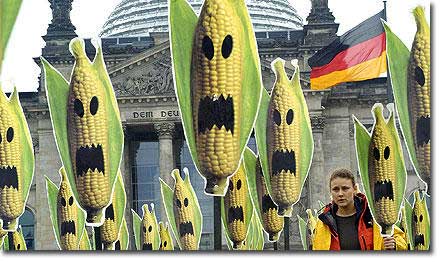
Today, it was announced that the German government, in a complete rejection of science and a bow to leftist pressure, will ban GMO corn:
BERLIN/HAMBURG (Reuters) - Germany will ban cultivation and sale of genetically modified (GMO) maize despite European Union rulings that the biotech grain is safe, its government said on Tuesday.

The ban affects U.S. biotech company Monsanto's MON 810 maize which may no longer be sown for this summer's harvest, German Agriculture and Consumer Protection Minister Ilse Aigner told a news conference.

The move puts Germany alongside France, Austria, Hungary, Greece and Luxembourg which have banned MON 810 maize despite its approval by the EU for commercial use throughout the bloc.

Ilse Aigner is a Dummkopf:
"I have come to the conclusion that there is a justifiable reason to believe that genetically modified maize of the type MON 810 presents a danger to the environment," Aigner said, stressing the five other EU states have taken the same action.

It really does not matter what the science says; it doesn't matter than GMO corn is safe:
The EU Commission, the bloc's executive arm, has tried without success to get the bans in other countries lifted and on Tuesday warned it would examine the German decision.

"The Commission will analyse the ban by Germany with the adequate scientific information support and the Commission will decide on the most appropriate follow-up towards this situation," Commission spokeswoman Nathalie Charbonneau told a regular briefing.

Monsanto spokesman Andreas Thierfelder said the decision was unjustified and no supportable scientific reasons for the ban had been given. Should the ban be confirmed, Monsanto would consider legal options with the goal of enabling GMO seeds to be planted for this year's harvest.

Ferdinand Schmitz, chief executive of the association of German seed producers, said the decision was arbitrary and would damage Germany as a location for research.

Schmitz accused Aigner of trying to score points with voters in the upcoming European parliamentary elections and said banning seeds already approved as safe could generate legal action for compensation.

fārī


Fārī is a Latin root word meaning "to speak." Its interest to me is in the range of English words it is a part of. I think you gain an appreciation for language when you can see the relation of words to each other and how roots and prefixes and suffixes were added and subtracted to express new concepts. Here are words I know that have fārī as a root:

Infant: "one unable to speak" from in- ("cannot") + -fāns, prp. of fārī "to speak."
Fate: "a prophetic declaration of what must be" from fātum "utterance, decree of fate, destiny", orig. neut. of fātus, ptp. of fārī "to speak".
Affable: "pleasantly easy to approach and to talk to" from affārī, "to speak to" from ad- + fārī "to speak."
Fame: "one spoken of" from fāma "talk, public opinion, repute," akin to fārī "to speak."
Preface: "a preliminary statement" from praefari "to speak or say beforehand" from prae "before" + fārī, fātus "to speak."
Fable: "a short tale to teach a moral lesson" from fābula from fārī "to speak."
Effable: "utterable" from effābilis, equiv. to eff(ārī) "to speak out" (ef- "out" + fārī to speak) + -ābilis "able."
Ineffable: "inutterable" from in- "not" + effābilis, equiv. to eff(ārī) "to speak out" (ef- "out" + fārī to speak) + -ābilis "able."
Nefarious: "extremely wicked or villainous" from nefas "crime, wrong" from ne- "not" + fas "divine law;" akin to fari "to speak."
Multifarious: "having many different parts, elements, forms, etc." from multifariam "in many places or parts," perhaps originally "that which can be expressed in many ways," from multi- "many" + -fariam "parts," perhaps from fas "utterance, expression, manifestation," related to fari "to speak."

Ineffable


ineffable [ĭn-EF-ə-bəl]
adj. incapable of being expressed or described in words; inexpressible

[From Latin ineffābilis, from in- ("not") + effābilis ("utterable") from ex- ("out") + fārī ("to speak")]

The primary function of ineffable is as an intensifier. "It wasn't just that the girl was beautiful. Her beauty was beyond description. It was ineffable." Things which defy description or expression are ineffable: "ineffable ecstasy"; "inexpressible anguish"; "unspeakable happiness"; "unutterable contempt"; and "a feast of untellable splendor."

A second way ineffable is used is to describe a sort of gray area. Christopher Hitchens, here in Slate, for example, writes that Barack Obama has reached an undefinable place, a destination which defies description because the boundaries of that place are opaque:
President Barack Obama's visit to Europe afforded us an opportunity to gauge the strengths and weaknesses of his style in operation. And, even though he has almost attained the Holy Grail of public relations—in other words, he is practically at that ineffable and serene point where he gets good press for getting good press—there may come a time when even his trans-Atlantic admirers will have to take a second look.

A third way in which ineffable is used is with sacred concepts that are "not to be uttered" or "taboo." In Judaism, traditionally, it is taboo to speak or write the name of God. God is ineffable to the Jews. The idea is that by putting a description on something sacred, you are inevitably limiting that thing and bringing it down to your level. In his book, A History of Heaven, Jeffrey Burton Russell described the sacred as incomprehensible, and therefore indefinable:
Heaven itself is ineffable, beyond words. The term ineffabilis was established in theology in the fifth century by Augustine (354-430), who said that it is easier to say what God is not than to say what he is. God is not only incomprehensible to humans but is himself beyond all categories; heaven is therefore also beyond categories. Yet we have no way of discussing heaven except in the only speech we know, human language.

Monday, April 13, 2009

Mexican Congress debates legalizing marijuana


If pot were permitted to be grown legally in Mexico, the supply would be very large, the profits would become very small, distributors would no longer need guns to transport their product and gangsters would have no incentive to murder people in order to control the market. The trade in marijuana would become much like the trade in wheat, corn, cotton or any other commodity. Do you see the Mafia or street gangs trafficking in soy beans?

Alas, the proposed change in Mexico sounds like it will be restricted to permitting Mexicans to legally possess and smoke small quantities of marijuana, but won't change the law with regard to growers or distributors:
Mexico's Congress opened a three-day debate Monday on the merits of legalizing marijuana for personal use, a policy backed by three former Latin American presidents who warned that a crackdown on drug cartels is not working. ... Proponents had a boost in February when three former presidents - Cesar Gaviria of Colombia, Ernesto Zedillo of Mexico and Fernando Cardoso of Brazil - urged Latin American countries to consider legalizing the drug to undermine a major source of income for cartels.

The vicious drug war in Mexico is not being fought over personal use. It's being fought over billions of dollars in profits -- profits that exist only because growing and distributing that commodity is illegal.

Bulwark


bulwark [BOOL-wərk]
n. any protection against external danger, injury, or annoyance; any person or thing giving strong support or encouragement in time of need, danger, or doubt

[From Old Norse bole ("the trunk of a tree") + werk ("work, as an engineering structure")]

In its literal sense, a bulwark is "a wall or embankment raised as a defensive fortification; a rampart." But in literature and common parlance, it tends to be used in its figurative sense (as I define it above), in the same way "safeguard" and "defense" are used figuratively.

Franklin Roosevelt, for example, famously said:
The only sure bulwark of continuing liberty is a government strong enough to protect the interests of the people, and a people strong enough and well enough informed to maintain its sovereign control over its government.

John L. Lewis, president of the United Mine Workers from 1920-60, called unionized labor a safeguard against communist influence:
The organized workers of America, free in their industrial life, conscious partners of production, secure in their homes, and enjoying a decent standard of living, will prove the finest bulwark against intrusion of alien doctrines of government.

In his 1964 acceptance speech at the Republican Convention in San Francisco, Barry Goldwater called the North Atlantic Treaty Organization our greatest source of protection:
Now failure cements the wall of shame in Berlin; failures blot the sands of shame at the Bay of Pigs; failures marked the slow death of freedom in Laos; failures infest the jungles of Vietnam; and failures haunt the houses of our once great alliances and undermine the greatest bulwark ever erected by free nations, the NATO community.

Saturday, April 11, 2009

Hypocoristic


hypocoristic [hī-pə-kə-RIS-tĭk]
adj. endearing, as a pet name, diminutive, or euphemism

[From Greek hypokoristikós ("to call by endearing names) from hypo- ("under") + kor- ("child") + -istikos]

A hypocoristic name is a pet name or a diminutive name. Hypocorism is the noun form. The word hypocoristic is used in linguistics, often to explain the origin or evolution of one name into another.

Random House gives some examples:
Hypocoristic forms are, as the definition says, generally either pet names, or nicknames, such as Harry for Henry or Betsy or Beth or Liz or about a zillion others for Elizabeth, or they are forms with some sort of diminutive element, such as the suffix -y/-ie, yielding such words as preppy (prep (school) + -y), kiddie, birdie, cutie, and the like.

Ancestry-dot-com explains that the -cock suffix in names like Hitchcock and Hancock came hypocoristically:
(The name "Cocke") applied to a young lad who strutted proudly like a cock, it soon became a generic term for a youth and was attached with hypocoristic force to the short forms of many medieval personal names (e.g. Alcock, Hancock, Hiscock, Mycock). The nickname may also have referred to a natural leader, or an early riser, or a lusty or aggressive individual.

Emperor Constans II (630-668) came to the Byzantine throne in 641, 305 years after Constantine the Great, the man who Christianized the Roman Empire. In his classic tome The Decline and Fall of the Roman Empire, Edward Gibbon notes that although Constans II is known to history by that name, Constans was a pet name for Constantine:
The baptismal name of this emperor was Heraclius; he was renamed Constantine at his coronation, perhaps because his step uncle Heraclius had brought discredit on the name. He is Constantine on his coins and is so called by Nicephorus, but Tbeophanes calls him Constans and he is always known as Constans II. We must infer that Constantine was his official name, but that he was popularly called Constans in a hypocoristic sense.

Look at the map of the Byzantine Empire above and note the size of the Arab Caliphate in 650. Muhammed had been dead only 18 years, yet his religion, Islam, and his language, Arabic, were then growing like wildfire, south of Byzantium. Eventually, the Islamic Caliphate (under Oriental Turks) would entirely swallow the Christian-Greek empire north of Arabia.

Tares


tares [TAIRS]
n. an unwelcome or objectional element

[From Arabic ṭarḥah ("rejection, subtraction") from ṭaraḥa ("to throw away")]

In a literal sense, tares are weeds, especially vetches. However, the Christian Bible uses tares figuratively to mean an undesirable element, such as a servant of the devil.

In Matthew 13, Jesus takes the stage on the deck of a ship at harbor and entertains "the whole multitude" on shore. He warms up the crowd with his classic yarn about weeds and wheat-farming (Matthew 13:25-30):
But while men slept, his enemy came and sowed tares among the wheat, and went his way. But when the blade was sprung up, and brought forth fruit, then appeared the tares also. So the servants of the householder came and said unto him, Sir, didst not thou sow good seed in thy field? from whence then hath it tares? He said unto them, An enemy hath done this. The servants said unto him, Wilt thou then that we go and gather them up? But he said, Nay; lest while ye gather up the tares, ye root up also the wheat with them. Let both grow together until the harvest: and in the time of harvest I will say to the reapers, Gather ye together first the tares, and bind them in bundles to burn them: but gather the wheat into my barn.

The implication is that the bad seeds, the tares, will eventually burn in Hell, even if they don't get punished immediately. The day of reckoning comes for all. In the meantime, just because there are bad seeds among you, God does not recommend mankind punishing everyone to root out the wicked. For those in his audience too dense to understand, Jesus explained his parable:
The field is the world; the good seed are the children of the kingdom; but the tares are the children of the wicked one; The enemy that sowed them is the devil; the harvest is the end of the world; and the reapers are the angels. As therefore the tares are gathered and burned in the fire; so shall it be in the end of this world. The Son of man shall send forth his angels, and they shall gather out of his kingdom all things that offend, and them which do iniquity; And shall cast them into a furnace of fire: there shall be wailing and gnashing of teeth.

Friday, April 10, 2009

Allocution


allocution [AL-ə-KYOO-shən]
n. a formal speech

[From Latin allocūtiō, combining al- ("tendency") + loquī ("to speak")]

Allocution tends to be used in technical jargon in two distinct forms -- one within the Roman Catholic Church; the other in a courtroom. When the president of the United States, for example, delivers his annual State of the Union address, that's clearly a formal speech. However, it's not generally referred to as allocution, though it certainly could be.

Here is a rare example -- I found it in a book published in 1891 -- where allocution is used in a non-technical sense as a formal speech:
Speeches now followed in rapid succession, but the allocution delivered by M. Sasvari was the most striking illustration of internationalism. He commenced in Magyar, and after a few complimentary words to his Hungarian colleagues, assured the Austrian and German guests, himself speaking in good German, that the Hungarians recognised how much their civilisation was due to the Germanic races. Then speaking in French, he explained that Hungary admired the great French nation, which, marching in the vanguard of progress, had given to the world the highest and most generous ideas. Now changing from French to Italian, he spoke of the glories of ancient Rome to be revived at no distant date. Finally, concluding in fluent English, he greeted the brave children of Great Britain, who had borne the banner of civilisation to the uttermost regions of the globe.

In the Catholic context, an allocution is "a solemn form of address or speech from the throne employed by the Pope ... delivered only in a secret consistory at which the cardinals alone are present."
An allocution of the Pope often takes the place of a manifesto when a struggle between the Holy See and the secular powers has reached an acute stage. It then usually summarizes the points at issue and details the efforts made by the Holy See to preserve peace. It likewise indicates what the Pope has already conceded and the limit which principle obliges him to put to further concessions. ... When the Pope has reached a conclusion on some important matter, he makes his mind known to the cardinals by means of a direct address, or allocution.

In the language of our courts, a defendant normally has the right of allocution:
... the right of a defendant to make a statement to the court on his own behalf and present information in mitigation of sentence. It started out as the ancient common-law practice of inquiring of every defendant if he had anything to say before sentence was imposed. Back in the day, when death was the only punishment and defendants had no counsel, the right of allocution was used to beg for mercy. In modern times, the right had evolved to permit a defendant to plead for a more lenient sentence and to fit with our modern sense of justice and the desire to rehabilitate.

Although allocution is somewhat uncommon and tends to be used only in its technical senses, its Latin root loquī ("to speak") is found in more than a dozen good English words, many of which are well known.

The three most common: colloquial ("characteristic of or appropriate to ordinary or familiar conversation rather than formal speech or writing"); eloquent ("having or exercising the power of fluent, forceful, and appropriate speech"); and ventriloquism ("the art or practice of speaking, with little or no lip movement, in such a manner that the voice does not appear to come from the speaker but from another source, as from a wooden dummy").

Four words ending in -quy (pronounced kwee): colloquy ("a conversational exchange"); obloquy ("censure, blame, or abusive language aimed at a person or thing, esp. by numerous persons or by the general public"); soliloquy ("a dramatic or literary form of discourse in which a character talks to himself or herself or reveals his or her thoughts without addressing a listener"); and somniloquy ("the act or habit of talking in one's sleep").

Seven good nouns: circumlocution ("a roundabout or indirect way of speaking; the use of more words than necessary to express an idea."); colloquium ("a conference at which scholars or other experts present papers on, analyze, and discuss a specific topic"); elocution ("a person's manner of speaking or reading aloud in public"); grandiloquence ("speech that is lofty in tone, often to the point of being pompous or bombastic"); interlocution ("conversation; dialogue"); locution ("a particular form of expression; a word, phrase, expression, or idiom"); and prolucutor ("a presiding officer of an assembly; chairperson").

And a couple of adjectives: loquacious ("talking or tending to talk much or freely"); and magniloquent ("speaking or expressed in a lofty or grandiose style").

Thursday, April 9, 2009

Obstreperous


obstreperous [ŏb-STREP-ər-əs]
adj. 1. resisting control or restraint in a difficult manner; unruly. 2. noisy, clamorous, or boisterous

[From Latin obstreperus ("clamorous") from ob- ("over") + strepere ("to rattle)]

Perhaps the biggest problem with obstreperous is it can mean different things, but it's not always clear which one is intended. The definitions tend to bleed into each other. Although its etymological origins are not in an unruly mob, that is where you should place this word. An unruly mob resists control. It's noisy and clamorous and boisterous. My recommendation is to restrict your usage of obstreperous to mean "unruly, verging on out of control." If a group of people is having a good time, but is noisy and enthusiastic, I wouldn't classify them as obstreperous, though perhaps they could be called boisterous. When a wild child is throwing a fit, crying, tossing his toys about, unable to control his emotions, that's obstreperous.

Here's an example from The Times of London where it's not clear how obstreperous is being used. Does the writer mean that taxi drivers are unruly? or merely noisy?
After trying to hide holes in their socks while shuffling through airport security, hunting a seat in the departure lounge, tipping red wine on to documents on a crowded flight and dealing with obstreperous taxi drivers on arrival, the experienced traveller will find it hard to empathise with the beauty queen’s innocent enthusiasm (for travel).

In this instance, George Will uses obstreperous as a synonym for clamorous ("expressing vehement dissatisfaction"). That's technically acceptable. However, clamorous would have been better, because I doubt the people he describes were really unruly, verging on being out of control:
Storing nuclear waste, which decays very slowly and emits great heat while doing so, has been studied since 1955, when nuclear submarine propulsion technology was adapted to generate electricity. After considering storage on the seabed or a remote island or in the polar ice sheets, or rocketing the waste into orbit around the sun, the government settled on deep geologic storage as the preferred solution. Some Kansas salt mines were considered, but the mines were too difficult to seal and, besides, Kansas became, as Nevada is now, obstreperous.

When obstreperous is used as a synonym for unruly, there's no confusion. That's how it is used most often, as well. Here is an example of that from a court case called, CITY OF VIRGINIA BEACH v. MILES STEPHEN SMITH:
Mr. Smith is charged under Virginia Beach’s disturbing the peace ordinance, Code Sec. 23-10. which forbids “any person to disturb the peace of others by violent, tumultuous, offensive or obstreperous conduct or by threatening, challenging to fight, assaulting, fighting or striking another.”

Tom Friedman: A Carbon Tax is the right approach


In his column in Wednesday's New York Times, Thomas Friedman suggests that Congress and the president should scrap "a plan to reduce greenhouse-gas emissions through a complicated cap-and-trade system" in favor of a simple carbon tax.

I agree.

Cap-and-trade is bureaucratic, litigious, prone to manipulation and won't get us anywhere. A decade after Kyoto, its signatories -- all of whom instituted cap-and-trade -- have failed to reduce their CO2 exhaust.

By contrast, a carbon tax makes economic sense: If you put a pollutant* into our common atmosphere, that pollution imposes a cost on the rest of us. A carbon tax forces you to internalize that cost. That gives you an incentive to pollute less (which means burn less carbon).
Since the opponents of cap-and-trade are going to pillory it as a tax anyway, why not go for the real thing — a simple, transparent, economy-wide carbon tax?

Friedman outlines the plan he favors:
Representative John B. Larson, chairman of the House Democratic Caucus, has circulated a draft bill that would impose “a per-unit tax on the carbon-dioxide content of fossil fuels, beginning at a rate of $15 per metric ton of CO2 and increasing by $10 each year.” The bill sets a goal, rather than a cap, on emissions at 80 percent below 2005 levels by 2050, and if the goal for the first five years is not met, the tax automatically increases by an additional $5 per metric ton.

If only the United States has a carbon tax, won't that encourage manufacturers to move overseas, where there is no tax?
The bill implements a fee on carbon-intensive imports, as well, to press China to follow suit.

A carbon tax should be implemented globally, not just here. We may be the biggest polluters, now. But soon enough, the CO2 produced in India and China will swamp our output. Once we get serious about this issue, the U.S. should press the WTO to make a global carbon tax mandatory.

Ideally, the money generated from a carbon tax should subsidize the use and development of technologies (like solar, wind, nuclear and so on) which replace fossil fuels. However, the Larson bill has a more populist approach (which might make it more politically viable than mine):
Larson would use most of the income to reduce people’s payroll taxes: We tax your carbon sins and un-tax your payroll wins.

Friedman thinks most people will now support a carbon tax. I do. But I have my doubts about my compatriots:
Americans will be willing to pay a tax for their children to be less threatened, breathe cleaner air and live in a more sustainable world with a stronger America. They are much less likely to support a firm in London trading offsets from an electric bill in Boston with a derivatives firm in New York in order to help fund an aluminum smelter in Beijing, which is what cap-and-trade is all about. People won’t support what they can’t explain.

*It's fair to question whether carbon qua carbon is "a pollutant." After all, every terrestrial form of vegetation requires CO2 in the atmosphere to live. Trees, shrubs, flowers and so on inhale CO2 and offgas oxygen, making the Earth livable for people and all fauna. Yet given what we know about the hazards of too much carbon in the atmosphere, it's fair to classify excess carbon as a pollutant. We get excess carbon in our air by extracting minerals -- coal and oil -- which have sequestered carbon, and burning those minerals. Thus, a tax on fossil fuels rightly taxes the pollution component of carbon.

Wednesday, April 8, 2009

Meme


meme [MEEM]
n. A unit of cultural information, such as a cultural practice or idea, that is transmitted verbally or by repeated action from one mind to another.

[From Greek mimēma ("something imitated"), from mimeisthai ("to imitate")]

In his book, The Selfish Gene, Oxford University biologist Richard Dawkins -- famous for his strong defense of evolutionary science and his public quarrels with Biblical Creationists -- coined the word meme as a cultural equivalent to a gene. While meme has taken on a life of its own as its usage has grown, this is what Dawkins originally wrote:
The gene, the DNA molecule, happens to be the replicating entity that prevails on our own planet. There may be others. If there are, provided certain other conditions are met, they will almost inevitably tend to become the basis for an evolutionary process. But do we have to go to distant worlds to find other kinds of replicator and other, consequent, kinds of evolution? I think a new kind of replicator has recently emerged on this very planet. It is staring us in the face. It is still in its infancy, still drifting clumsily about in its primeval soup, but already it is achieving evolutionary change at a rate that leaves the old gene panting far behind.

The new soup is the soup of human culture. We need a name for the new replicator, a noun that conveys the idea of a unit of cultural transmission, or a unit of imitation. 'Mimeme' comes from a suitable Greek root, but I want a monosyllable that sounds a bit like 'gene.' I hope my classicist friends will forgive me if I abbreviate mimeme to meme. If it is any consolation, it could alternatively be thought of as being related to 'memory,' or to the French word même. It should be pronounced to rhyme with 'cream.'

Dawkins then lists various cultural phenomena which qualify as units of cultural transmission:
Examples of memes are tunes, ideas, catch-phrases, clothes fashions, ways of making pots or of building arches. Just as genes propagate themselves in the gene pool by leaping from body to body via sperms or eggs, so memes propagate themselves in the meme pool by leaping from brain to brain via a process which, in the broad sense, can be called imitation. If a scientist hears, or reads about, a good idea, he passes it on to his colleagues and students. He mentions it in his articles and his lectures. If the idea catches on, it can be said to propagate itself, spreading from brain to brain. As my colleague N.K. Humphrey neatly summed up an earlier draft of this chapter: 'memes should be regarded as living structures, not just metaphorically but technically. When you plant a fertile meme in my mind you literally parasitize my brain, turning it into a vehicle for the meme's propagation in just the way that a virus may parasitize the genetic mechanism of a host cell. And this isn't just a way of talking--the meme for, say, "belief in life after death" is actually realized physically, millions of times over, as a structure in the nervous systems of individual men the world over.'

My guess as to why Dawkins conceived of the meme is because he was trying to understand why so many people, despite scientific evidence, were so religious and superstitious. This gets at that:
Consider the idea of God. We do not know how it arose in the meme pool. Probably it originated many times by independent 'mutation.' In any case, it is very old indeed. How does it replicate itself? By the spoken and written word, aided by great music and great art. Why does it have such high survival value? Remember that 'survival value' here does not mean value for a gene in the gene pool, but value for a meme in the meme pool. The question really means: What is it about the idea of a god that gives it its stability and penetrance in the cultural environment? The survival value of the god meme in the meme pool results from its great psychological appeal. It provides a superficially plausible answer to deep and troubling questions about existence. It suggests that injustices in this world may be rectified in the next. The 'everlasting arms' hold out a cushion against our own inadequacies which, like a doctor's placebo, is none the less effective for being imaginary. These are some of the reasons why the idea of God is copied so readily by successive generations of individual brains. God exists, if only in the form of a meme with high survival value, or infective power, in the environment provided by human culture.

Replication is the key ingredient in memes. It is like life after death for the originator of an idea. Francis Scott Key is long dead, but he lives on in the Star Spangled Banner. Glenn Grant weighs in on the replication angle:
An idea or information pattern is not a meme until it causes someone to replicate it, to repeat it to someone else. All transmitted knowledge is memetic.

Heith Michael Rezabek gets at the idea that learned behaviors are also memes:
My favorite example of a crucial meme would be "fire" or more importantly, "how to make a fire." This is a behavioral meme, mind you, one which didn't necessarily need a word attached to it to spring up and spread, merely a demonstration for another to follow. Once the meme was out there, it would have spread like wildfire, for obvious reasons... But when you start to think of memes like that -- behavioral memes -- then you can begin to see how language itself, the idea of language, was a meme. Writing was a meme. And within those areas, more specific memes emerged.

News Hounds, a (presumably liberal) website dedicated to challenging the Fox News Channel, characterizes ideas accepted on Fox and spread to its audience by its announcers as viral memes:
The “Fox Nation” is very, very concerned about the University of Notre Dame’s invitation for President Obama to give the commencement address and receive an honorary degree at their school. Megyn Kelly provided even more coverage of the matter on Monday (April 6th). In keeping with the Fox meme that this event represents a violation of Catholic values while reinforcing the meme that Obama is pro-choice ergo he’s evil, Megyn Kelly provided a platform for more of the same.